Guide
How do RC cars work?
An RC car is a surprisingly small number of parts doing obvious jobs. Once you know what the six of them are, almost every buying decision and almost every fault makes sense.
By Ryder M. · Published October 17, 2026 · Last reviewed
Shock & Servo is reader-supported. If you buy through a link on this page we may earn a commission, at no extra cost to you. It never changes which products we pick or the order we rank them in — the full rules are on our methodology page and our affiliate disclosure.
An RC car works by sending the position of your hands over a radio link to a small computer in the car, which converts those positions into motor power and a steering angle. The transmitter reads its trigger and wheel many times a second and broadcasts the values; the receiver in the car picks them up; the speed control turns the throttle value into power for the drive motor; and the steering servo turns the steering value into an angle at the front wheels. The battery supplies all of it. Six parts, and that is the whole machine.
Direct answer: the six parts are the transmitter, the receiver, the electronic speed control, the drive motor, the steering servo and the battery. Modern cars use 2.4 GHz radio, which automatically pairs each transmitter to its own car, so several people can drive together without interference.
The six parts, and what each one does
| Part | Where it is | What it does |
|---|---|---|
| Transmitter | In your hands | Reads the trigger and wheel and broadcasts their positions |
| Receiver | In the car, in a small box | Listens for that signal and passes the values on |
| Speed control (ESC) | Bolted to the chassis | Converts the throttle value into power for the motor |
| Drive motor | Connected to the drivetrain | Turns electrical power into rotation at the wheels |
| Steering servo | At the front of the chassis | Holds the front wheels at the angle you asked for |
| Battery | In the battery tray | Supplies every one of the above |
What actually happens when you squeeze the trigger
The transmitter measures the trigger's position as a number rather than as on or off — that is what proportional control means — and sends it, along with the steering position, dozens of times a second. The receiver hands the throttle number to the speed control, which uses it to decide how much of the battery's power to feed the motor. At a tenth of a trigger pull the speed control switches the power on and off very rapidly so the motor receives a small average; at full pull it is essentially connected straight through. That is why an RC car can creep as well as sprint, and why a toy car with a simple on-off switch cannot.
Steering works the other way round. The servo contains a small motor, a gear train and a sensor that reports the current angle of its output shaft. It compares the angle it has been asked for with the angle it is at, and runs its motor until they match — then holds it there against whatever the ground is pushing back. What is an ESC on an RC car and what is a servo in an RC car go into each of those two in detail.
How the radio link works
Almost every car sold today uses the 2.4 GHz band, the same band as home wi-fi, and pairs — the hobby word is "binds" — a specific transmitter to a specific receiver. The pair then hops between channels within the band, which is what makes modern RC essentially interference-free: a dozen cars can run in the same car park at once, something that was genuinely difficult on the older 27 MHz and 49 MHz crystal systems where two drivers on the same frequency would fight over the same car. Do RC cars interfere with each other covers the remaining edge cases.
The practical range of that link is a few hundred feet in open space, and much less with buildings, fences or a hill in the way. When the signal drops out, a well-designed car does not run away — the receiver detects the loss and the speed control applies a pre-set failsafe, normally neutral throttle. How far can RC cars go covers real-world range.
From the motor to the wheels
The motor spins far too fast and with far too little force to drive a wheel directly, so between the two sits a gearbox. A small gear on the motor — the pinion — drives a much larger one, the spur gear, and the ratio between them trades speed for pulling power. A crawler uses a low ratio so it can climb at walking pace; a speed-run car uses a high one. Changing that pinion is the single most common way people make a car faster, and how to make an RC car faster covers it.
From the gearbox the power reaches the wheels through driveshafts and differentials. A differential lets the two wheels on an axle turn at different speeds, which is what allows a car to corner without dragging a tire. A two-wheel-drive car has one; a four-wheel-drive car has two, plus a shaft down the chassis connecting them. 2WD vs 4WD RC cars covers what that difference means in practice.
Cars that show this clearly
| # | Product | Best for | Score | Price |
|---|---|---|---|---|
| 1 | 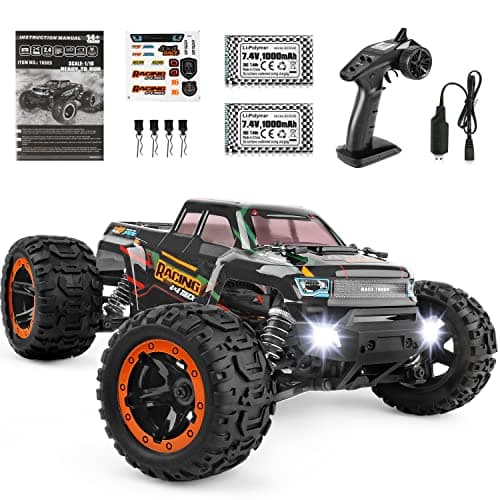 HAIBOXING 16889HAIBOXING calls it hobby class and, unusually at this price, largely means it — ball bearings, four-wheel drive and two batteries in the box. | Bridging toy to hobby | 8.2 | $85.99View on Amazon #ad — how we earn · price as of November 12, 2026 |
| 2 | 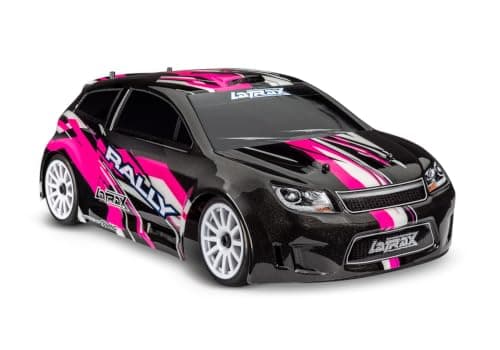 Traxxas LaTrax RallyWaterproof, four-wheel drive, and it comes with a battery and a charger — the friendliest way into the real hobby. | A family's first hobby car | 8.8 | $139.95View on Amazon #ad — how we earn · price as of November 12, 2026 |
| 3 | 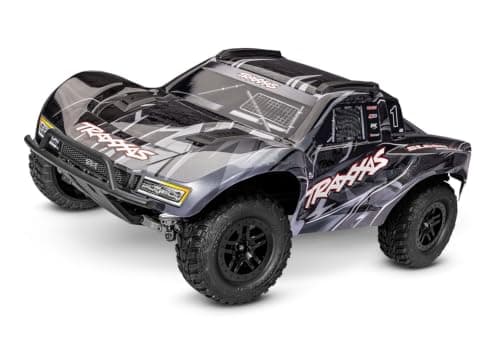 Traxxas Slash 4X4 BL-2sThe short-course truck that half the hobby owns, which is exactly why parts are never a problem. | The safest big gift | 9.1 | $429.95View on Amazon #ad — how we earn · price as of November 12, 2026 |
Product photo via Amazon.
#1 · Bridging toy to hobby
HAIBOXING 16889
HAIBOXING calls it hobby class and, unusually at this price, largely means it — ball bearings, four-wheel drive and two batteries in the box.
8.2/10our score for this use
A 1:16 truck, so roughly the size of a shoebox. HAIBOXING states a top speed above 36 km/h — around 22 mph — from an RC390 brushed motor, with four-wheel drive, ball bearings throughout, independent coil-sprung suspension on each wheel and splash-proof electronics. Two 1000mAh packs come in the box for 20 to 40 minutes of driving, and the transmitter has a speed switch for a beginner.
- Size:
- 1:16
- Drive:
- 4WD
- Motor:
- brushed motor
What it does well
- Real four-wheel drive, ball bearings and independent suspension at a price that usually buys none of them
- Two batteries in the box, which is the difference between a long afternoon and a short one
- Every part carries a number in the manual and can be ordered separately — most toy brands offer nothing
What it does badly
- Parts are HAIBOXING-only — nothing sits on the shelf at a local hobby shop
- Quick enough to break things, and the plastic is not Traxxas plastic
- The steering servo is the usual weak point at this price
Specifications from the HAIBOXING 16889 listing specification.
#ad — how we earn · price as of November 12, 2026
Product photo via Amazon.
#2 · A family's first hobby car
Traxxas LaTrax Rally
Waterproof, four-wheel drive, and it comes with a battery and a charger — the friendliest way into the real hobby.
8.8/10our score for this use
A 1/18 rally car from Traxxas, meaning it is about half the size of the trucks you see at a track but built by a company with parts in real hobby shops. Traxxas lists waterproof all-weather electronics, a 6-volt NiMH battery and a wall charger in the box, and a speed control with drive profiles that include a training mode.
- Size:
- 1/18
- Drive:
- Shaft-driven 4WD
- Motor:
- brushed motor
What it does well
- Battery and charger are included, so the gift works the day it is opened
- Waterproof electronics — wet grass and puddles are genuinely fine
- A training mode that limits the power, then full power later, so the car grows with the driver
- Traxxas parts are stocked by hobby shops and easy to order
What it does badly
- The NiMH battery it ships with is slower and heavier than a LiPo, so the first upgrade is obvious
- Low-slung rally body grounds out on thick grass — it prefers gravel, dirt and pavement
- Costs noticeably more than the toy-grade cars it sits beside on a search results page
Specifications from the Traxxas LaTrax Rally product page.
#ad — how we earn · price as of November 12, 2026
Product photo via Amazon.
#3 · The safest big gift
Traxxas Slash 4X4 BL-2s
The short-course truck that half the hobby owns, which is exactly why parts are never a problem.
9.1/10our score for this use
A short-course truck is the enclosed-wheel, pickup-bodied shape used in desert racing: the bodywork covers the wheels, so it survives contact far better than an open-wheel buggy. The BL-2s version is brushless and runs on a 2-cell LiPo or a 6-7 cell NiMH battery.
- Size:
- 1/10
- Drive:
- Shaft-driven 4WD
- Motor:
- brushless motor
What it does well
- Enclosed wheels make it the most crash-tolerant shape in the hobby for a beginner
- Traxxas parts are stocked in hobby shops across the country and ship next day online
- A settled, decade-old platform: every part, upgrade and how-to video already exists
What it does badly
- Traxxas lists no battery and no charger in the box, so budget for both before it can be driven
- The total spend climbs well above the sticker once a battery and charger are added
- Fast enough that a first-timer should start in the reduced-power mode, not at full throttle
Specifications from the Traxxas Slash 4X4 BL-2s product page.
#ad — how we earn · price as of November 12, 2026
Why toy-grade cars are different
A toy-grade car does the same job with fewer, cheaper components: the receiver and speed control are usually one sealed board, the steering is often a simple motor with no position feedback — so it turns fully left, fully right or straight rather than proportionally — and the motor connects to the wheels through a plastic gearbox. That is not a scam. It is a legitimate design for a car that has to be inexpensive, light and safe for a five-year-old. It does mean that when one thing fails, the sealed board usually goes with it, which is the real difference between the two grades. Hobby grade vs toy grade covers the consequences.
Nitro and gas cars, briefly
A small minority of RC cars burn fuel instead of using a battery, and the radio half of the system is identical — transmitter, receiver, servos. What changes is the drive: a tiny internal-combustion engine replaces the motor and the speed control, a second servo operates the throttle and brake, and the whole thing needs tuning, starting and cleaning. They sound superb and they are substantially more work, which is why electric has taken over almost completely. Nitro vs electric RC cars sets out that choice.
How we assembled this guide
The architecture described above is the standard construction of a hobby-grade electric RC car, confirmed against the manufacturer documentation linked in Sources — Traxxas' own model pages and parts diagrams set out the same six components, their wiring and their failsafe behavior. We have not estimated any figure on this page, and no measurement here is ours. Prices are never written into our copy: every figure shown is read from Amazon that day and rendered inside the buy button, with the date it was read. We do not test these products first-hand; our methodology page explains what that means for an explanatory guide.