Before you buy
What age is an RC car right for?
The honest answer is a range, not a number — and it depends far more on the controller than on the car.
By Ryder M. · Published September 27, 2026 · Last reviewed
Shock & Servo is reader-supported. If you buy through a link on this page we may earn a commission, at no extra cost to you. It never changes which products we pick or the order we rank them in — the full rules are on our methodology page and our affiliate disclosure.
Three is the youngest age an RC car makes sense, and only with a two-button controller. Around five, a child can manage a simple trigger. Around eight, a hobby-grade car becomes genuinely worth buying. The limiting factor is almost never the car — it is whether the child's hands can do two things at once.
Age by age
- Age 3. Two-button control only. Slow, light, indoors. Expect a few months of interest rather than a few years. See RC cars for 3-year-olds.
- Ages 4-5. A simple trigger becomes possible. Treaded tires matter, because they will want to use it outside. RC cars for 5-year-olds.
- Ages 6-7. Confident with a trigger and steering wheel. Toy-grade cars with four-wheel drive and two batteries are the sweet spot.
- Age 8. The crossover. Hobby-grade starts to pay for itself because they will crash it hard enough to need a replaceable part. RC cars for 8-year-olds.
- Ages 9-11. Real speed becomes manageable, 25-35 mph. They can help with repairs, which is genuinely part of the value.
- Age 12+. Brushless power, with space to use it. Durability starts to matter more than control. RC cars for 12-year-olds.
- Teens and adults. Anything, with the caveat that a first-timer of any age should not start on the most powerful thing available.
Why the controller matters more than the car
A hobby-grade transmitter has a trigger for throttle and a wheel for steering, and both are proportional — squeeze a little, go a little. That requires a level of fine motor control most children reach around five. Below that, a two-button controller is not a compromise, it is the correct tool. Handing a three-year-old a proportional trigger produces a car driven at full throttle into the furniture, which is a bad experience for everyone.
The manufacturers' own age ratings
Several products on this site carry a stated manufacturer age — three and up for most of the simple toys, for example. Those ratings are largely about small parts and safety rather than whether a child can drive the thing, so treat them as a floor rather than a recommendation. Our age pages are about capability.
One car per age band
| # | Product | Best for | Score | Price |
|---|---|---|---|---|
| 1 | 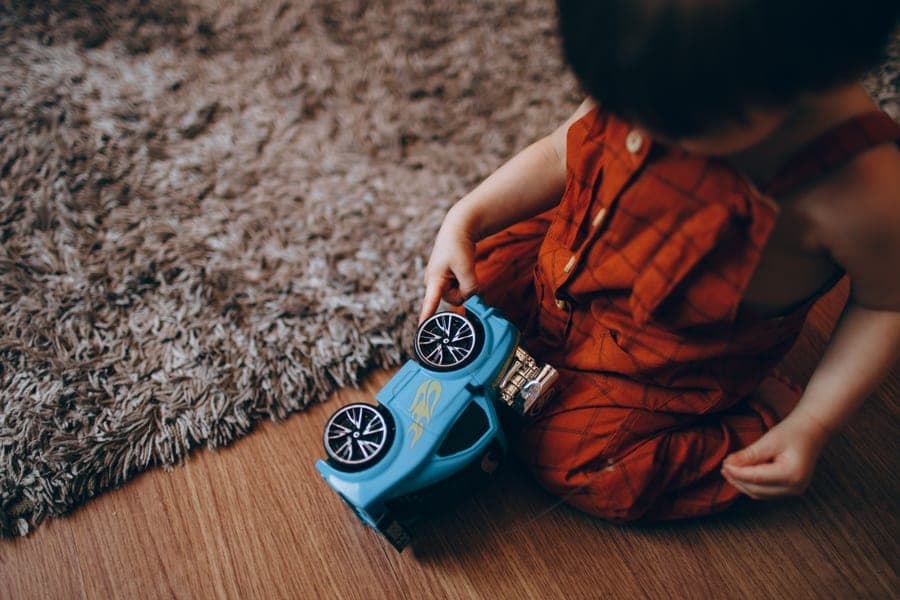 Liberty Imports Cartoon RC Race CarA two-button cartoon car with a steering-wheel remote a three-year-old can actually hold. | A first-ever remote | 8.2 | |
| 2 | 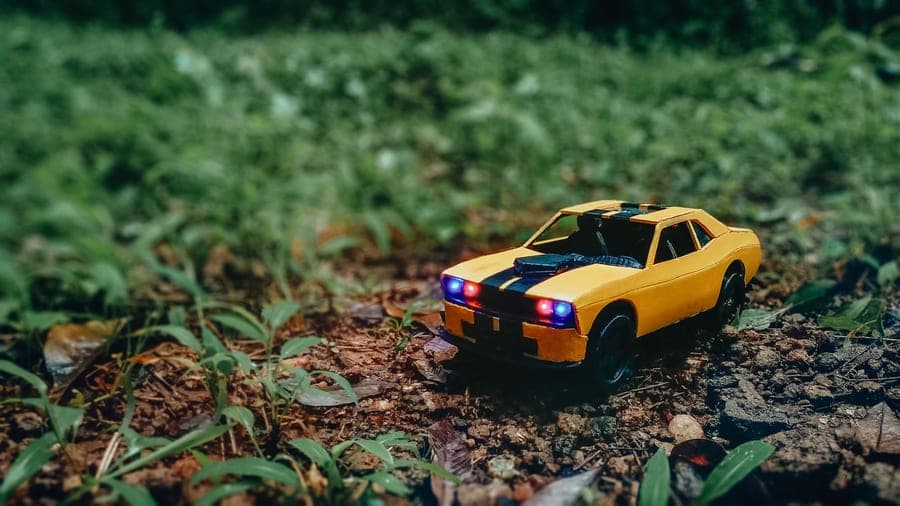 Kidirace RC Off-Road CarThe toy-grade car that actually copes with grass, and the run time beats the category norm. | Yard use, ages 5+ | 7.9 | |
| 3 |  Traxxas LaTrax RallyWaterproof, four-wheel drive, and it comes with a battery and a charger — the friendliest way into the real hobby. | A family's first hobby car | 8.8 | |
| 4 | 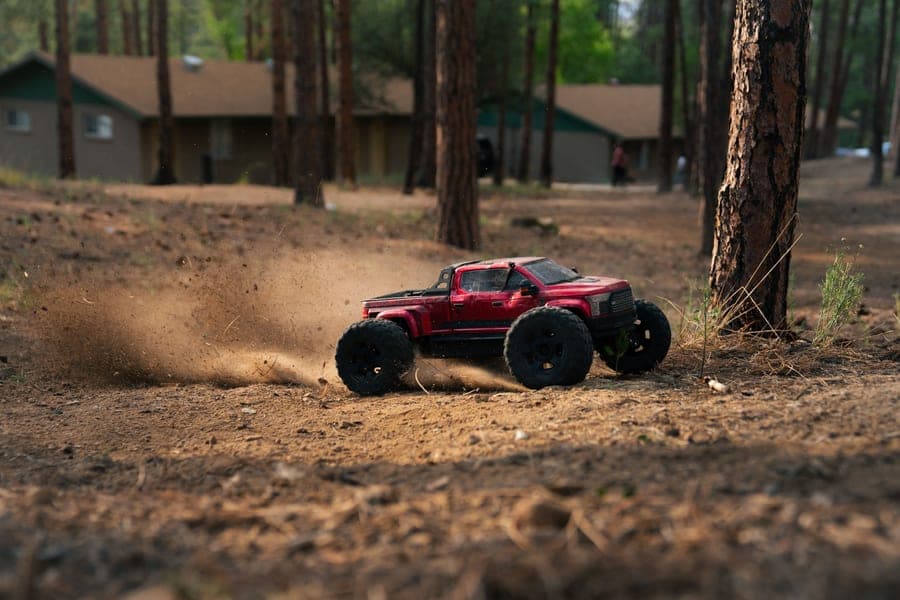 MJX HYPER GO 14210Bigger and heavier than the 16207, which makes it noticeably easier to keep pointing the right way. | Fast but more stable | 8.5 |
Illustrative photo — not this exact model.
#1 · A first-ever remote
Liberty Imports Cartoon RC Race Car
A two-button cartoon car with a steering-wheel remote a three-year-old can actually hold.
8.2/10our score for this use
This is a toy, not a hobby car, and that is the point. The remote is shaped like a steering wheel with two big buttons instead of a trigger and a wheel, so there is no fine control to learn. It makes noises, flashes its lights, and comes with small driver figures that pop out.
- Motor:
- toy-grade motor
- Maker’s age guide:
- 3 years and up
What it does well
- Two-button control is about as simple as remote control gets — no trigger technique, no steering wheel
- Light and slow enough that hitting a baseboard is a non-event
- Sounds, lights and removable figures give a three-year-old something to do when the battery dies
What it does badly
- It is toy-grade: when a wheel or the gearbox goes, there is no spare part and the car is finished
- Indoor and smooth surfaces only — the small wheels stop dead in grass
- Children grow out of it quickly. Expect a year, not five
Illustrative photo — not this exact model.
#2 · Yard use, ages 5+
Kidirace RC Off-Road Car
The toy-grade car that actually copes with grass, and the run time beats the category norm.
7.9/10our score for this use
Bigger treaded tires and some suspension travel, which is what separates a car that can leave the patio from one that cannot. Kidirace quotes around 20 minutes of driving per charge — generous for a toy-grade car.
- Motor:
- toy-grade motor
What it does well
- Handles grass, gravel and dirt, where most toy-grade cars bog down
- Around 20 minutes per charge — roughly double what a cheap RC car manages
- Suspension takes the sting out of curb drops and bumpy lawns
What it does badly
- Toy-grade internals: snap a wheel mount and there is no part to order
- Heavier and faster than an indoor toy, so it marks furniture if you drive it inside
- No parts network at all, unlike the hobby brands
Illustrative photo — not this exact model.
#3 · A family's first hobby car
Traxxas LaTrax Rally
Waterproof, four-wheel drive, and it comes with a battery and a charger — the friendliest way into the real hobby.
8.8/10our score for this use
A 1/18 rally car from Traxxas, meaning it is about half the size of the trucks you see at a track but built by a company with parts in real hobby shops. Traxxas lists waterproof all-weather electronics, a 6-volt NiMH battery and a wall charger in the box, and a speed control with drive profiles that include a training mode.
- Size:
- 1/18
- Drive:
- Shaft-driven 4WD
- Motor:
- brushed motor
What it does well
- Battery and charger are included, so the gift works the day it is opened
- Waterproof electronics — wet grass and puddles are genuinely fine
- A training mode that limits the power, then full power later, so the car grows with the driver
- Traxxas parts are stocked by hobby shops and easy to order
What it does badly
- The NiMH battery it ships with is slower and heavier than a LiPo, so the first upgrade is obvious
- Low-slung rally body grounds out on thick grass — it prefers gravel, dirt and pavement
- Costs noticeably more than the toy-grade cars it sits beside on a search results page
Specifications from the Traxxas LaTrax Rally product page.
Illustrative photo — not this exact model.
#4 · Fast but more stable
MJX HYPER GO 14210
Bigger and heavier than the 16207, which makes it noticeably easier to keep pointing the right way.
8.5/10our score for this use
A 1/14 monster truck with a brushless motor. MJX quotes 55 km/h — about 34 mph — a 2S battery in the box, a water-resistant receiver box and semi-metal oil-filled shocks. The extra weight and longer wheelbase make it calmer than the smaller 1/16 cars.
- Size:
- 1/14
- Drive:
- 4WD
- Motor:
- brushless motor
What it does well
- Longer and heavier, so it is far less flip-happy than the 1/16 models
- Battery included, and it takes a 3S pack later for more speed
- Water-resistant receiver box means damp grass is not a crisis
What it does badly
- Still fast enough to hurt itself against a curb
- The quoted 15-minute run time against a 4-hour charge is the real limit on an afternoon
- Parts support is mail-order only
Specifications from the HYPER GO 14210 listing.
When an RC car is the wrong gift
- When there is nowhere to use it. A fast car and a small back yard is the most common mismatch we see. A rock crawler solves this; a faster truck does not.
- When nobody will charge it. RC cars need a charged battery to be fun, and children do not plan ahead.
- When the child is under three. Below that, the coordination is not there yet, and small parts are a genuine concern.
- When they specifically asked for something else. It is a better gift for someone who wanted it.
How we assessed this
From manufacturers' stated age guidance and the control demands each type of transmitter places on a child. We do not claim clinical expertise in child development and have not invented any — see our methodology page.