Guide
Do RC cars interfere with each other?
This is a fair question with an out-of-date reputation. Twenty years ago two cars on the same frequency genuinely fought each other. On the 2.4GHz radios every modern car uses, they do not.
By Ryder M. · Published October 10, 2026 · Last reviewed
Shock & Servo is reader-supported. If you buy through a link on this page we may earn a commission, at no extra cost to you. It never changes which products we pick or the order we rank them in — the full rules are on our methodology page and our affiliate disclosure.
No — not if both cars use 2.4GHz radios, which effectively everything sold today does. A 2.4GHz transmitter and receiver are bound to each other with a unique identifier, and the receiver ignores every signal that is not from its own transmitter. Two, five or twenty cars can run in the same space at the same time without any of them affecting another. This is a genuine change from how the hobby used to work, and the reputation for interference is a hangover from the system that came before.
Direct answer: two 2.4GHz RC cars do not interfere with each other, because each receiver is bound to one transmitter and rejects the rest. If a car is behaving erratically near another car, the cause is almost always something else: range, a low transmitter battery, a low car battery, or a loose antenna.
Why this used to be a real problem
Older RC equipment used fixed frequencies in the 27MHz and 72MHz bands, and the frequency was set by a physical crystal plugged into the transmitter and the receiver. Each frequency was identified by a channel number, often shown with a colored flag on the antenna, and the rule at any track was absolute: before you switched on, you checked that nobody else was on your channel. Two transmitters on the same frequency meant two cars receiving a mixture of both signals, and the result was exactly as bad as it sounds.
2.4GHz systems removed the problem by changing the approach entirely. Rather than one car owning a frequency, the transmitter and receiver agree a unique digital identity during a one-time binding process, then hop between many narrow channels inside the 2.4GHz band. Even if two systems momentarily use the same channel, each receiver only acts on packets carrying its own identifier. Nothing has to be checked and no flags are needed.
What people mistake for interference
| Symptom | Usual cause | What to do |
|---|---|---|
| Car stutters or stops at a distance | Out of range, or an antenna folded inside the body | Drive closer; check the receiver antenna is routed up and clear |
| Car twitches and the steering wanders | Low battery in the transmitter | Fresh transmitter batteries — the first thing to check, always |
| Car slows and becomes unresponsive | Car battery nearly flat | Recharge. Low voltage looks exactly like a radio fault |
| Car runs away at full throttle | Lost signal with a speed control that has no failsafe | Switch the transmitter on first and off last, every time |
| Intermittent control indoors | Metal, concrete and Wi-Fi-dense environments reflecting the signal | Move into open space; 2.4GHz is shared with Wi-Fi and microwaves |
| Two cars both behave badly in one spot | A strong local 2.4GHz source, rarely | Move a few meters; the band is wide and the effect is local |
The band is shared, which matters a little
2.4GHz is an unlicensed band, so it is also used by Wi-Fi, Bluetooth, cordless phones, baby monitors and microwave ovens. In an ordinary park or field that is irrelevant. In a dense indoor environment — an apartment block, a trade show, a basketball court ringed with access points — a cheap receiver can occasionally struggle, which is one reason small indoor cars sometimes feel twitchier inside than out. Frequency hopping deals with nearly all of it, and moving a few meters deals with the rest.
Receiver quality does vary. Hobby-grade systems from the established brands generally hold a link further and recover faster than the radios in very cheap cars, and they tend to include a failsafe that cuts the throttle when the signal is lost rather than leaving the car at whatever it was last told. That is a meaningful safety difference, and it is part of what the hobby-grade premium buys. Hobby grade vs toy grade sets out the rest.
Cars with proper radio systems
| # | Product | Best for | Score | Price |
|---|---|---|---|---|
| 1 | 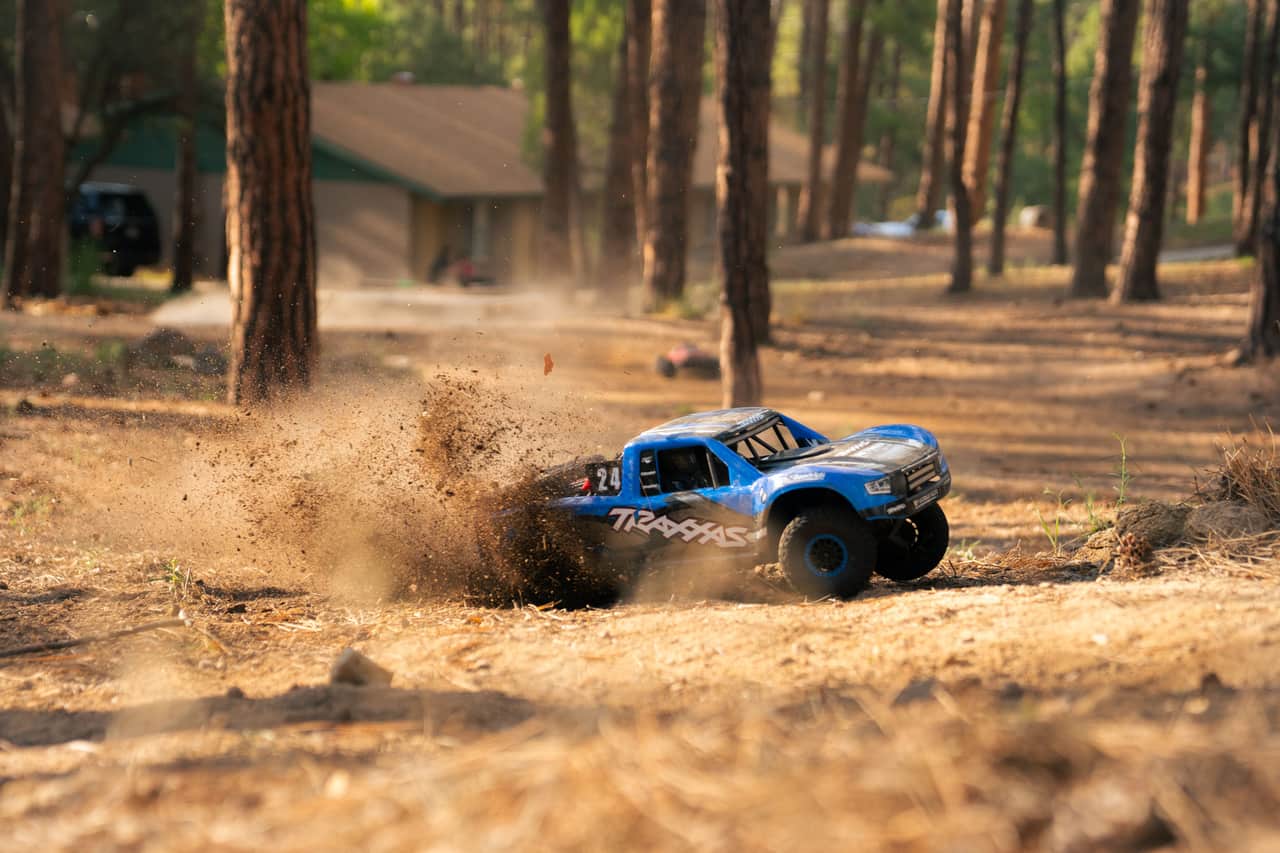 Traxxas Slash 4X4 BL-2sThe short-course truck that half the hobby owns, which is exactly why parts are never a problem. | The safest big gift | 9.1 | |
| 2 | 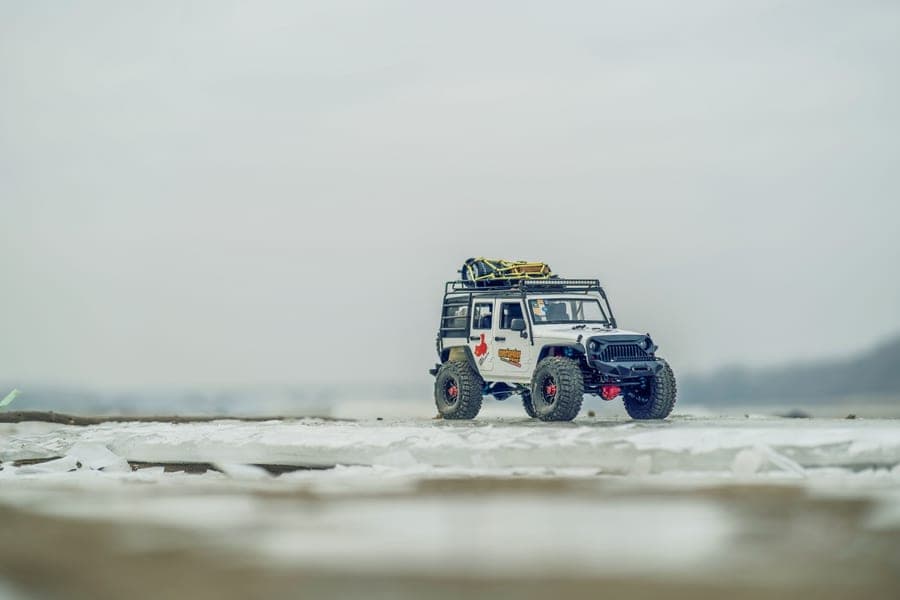 Traxxas LaTrax RallyWaterproof, four-wheel drive, and it comes with a battery and a charger — the friendliest way into the real hobby. | A family's first hobby car | 8.8 | |
| 3 | 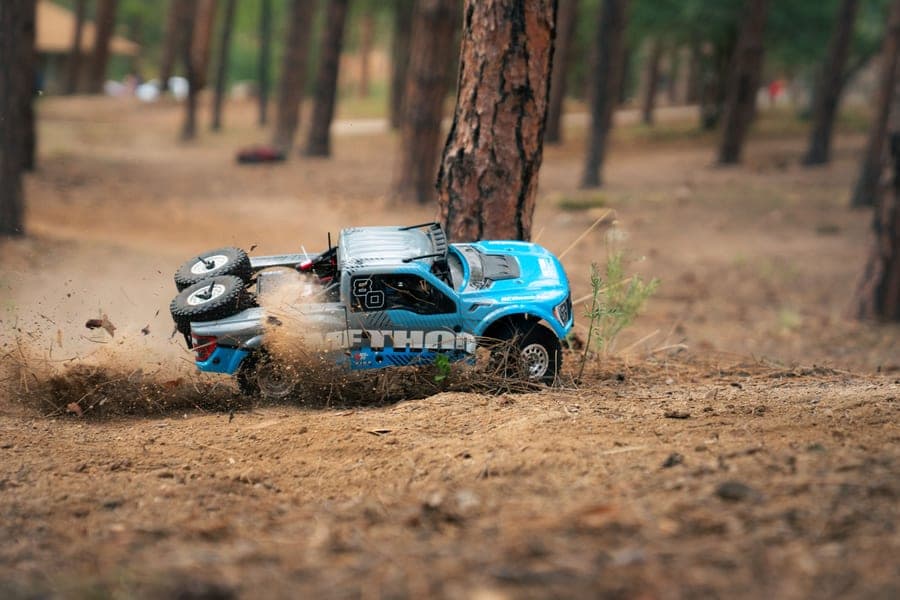 DEERC 9206E 1:10 Monster TruckA full 1:10-size truck at a price that usually buys something half the size — and two batteries again. | A big truck, small money | 8.0 |
Illustrative photo — not this exact model.
#1 · The safest big gift
Traxxas Slash 4X4 BL-2s
The short-course truck that half the hobby owns, which is exactly why parts are never a problem.
9.1/10our score for this use
A short-course truck is the enclosed-wheel, pickup-bodied shape used in desert racing: the bodywork covers the wheels, so it survives contact far better than an open-wheel buggy. The BL-2s version is brushless and runs on a 2-cell LiPo or a 6-7 cell NiMH battery.
- Size:
- 1/10
- Drive:
- Shaft-driven 4WD
- Motor:
- brushless motor
What it does well
- Enclosed wheels make it the most crash-tolerant shape in the hobby for a beginner
- Traxxas parts are stocked in hobby shops across the country and ship next day online
- A settled, decade-old platform: every part, upgrade and how-to video already exists
What it does badly
- Traxxas lists no battery and no charger in the box, so budget for both before it can be driven
- The total spend lands well past $300 once a battery and charger are added
- Fast enough that a first-timer should start in the reduced-power mode, not at full throttle
Specifications from the Traxxas Slash 4X4 BL-2s product page.
Illustrative photo — not this exact model.
#2 · A family's first hobby car
Traxxas LaTrax Rally
Waterproof, four-wheel drive, and it comes with a battery and a charger — the friendliest way into the real hobby.
8.8/10our score for this use
A 1/18 rally car from Traxxas, meaning it is about half the size of the trucks you see at a track but built by a company with parts in real hobby shops. Traxxas lists waterproof all-weather electronics, a 6-volt NiMH battery and a wall charger in the box, and a speed control with drive profiles that include a training mode.
- Size:
- 1/18
- Drive:
- Shaft-driven 4WD
- Motor:
- brushed motor
What it does well
- Battery and charger are included, so the gift works the day it is opened
- Waterproof electronics — wet grass and puddles are genuinely fine
- A training mode that limits the power, then full power later, so the car grows with the driver
- Traxxas parts are stocked by hobby shops and easy to order
What it does badly
- The NiMH battery it ships with is slower and heavier than a LiPo, so the first upgrade is obvious
- Low-slung rally body grounds out on thick grass — it prefers gravel, dirt and pavement
- Costs noticeably more than the toy-grade cars it sits beside on a search results page
Specifications from the Traxxas LaTrax Rally product page.
Illustrative photo — not this exact model.
#3 · A big truck, small money
DEERC 9206E 1:10 Monster Truck
A full 1:10-size truck at a price that usually buys something half the size — and two batteries again.
8.0/10our score for this use
1:10 is the size most hobby cars are: roughly 17 to 20 inches long, big enough to see across a yard and heavy enough that grass does not throw it around. DEERC quotes around 48 km/h — roughly 30 mph — and includes two batteries.
- Size:
- 1:10 (about 17-20 inches long)
- Drive:
- 4WD
- Motor:
- toy-grade motor
What it does well
- Proper 1:10 size, so it works on real ground instead of only on a driveway
- Two batteries in the box, and around 40 minutes of combined run time
- Some versions include a second body shell
What it does badly
- Not hobby-grade: spares are DEERC-only and thinner than Traxxas or Arrma
- Heavy for its build quality — a bad landing bends parts a hobby chassis would shrug off
- The stock tires wear quickly on asphalt
Specifications from DEERC's own store listing.
Running several cars together, in practice
- Bind each car to its own transmitter once. After that the pairing is remembered and nothing needs checking before a session.
- Switch the transmitter on first and off last. A receiver powered up with no transmitter present is the one situation that can produce a runaway car.
- Fresh transmitter batteries for everyone. A weak transmitter is the most common cause of twitchy steering, and it will be blamed on the other cars.
- Keep the receiver antenna clear. Routed up out of the chassis, not folded under the body or wrapped around a wire.
- Agree a direction of travel if several cars are on the same patch. Radio is not the collision risk here; drivers are.
- Label the transmitters if more than two are in use. Picking up the wrong one is harmless and confusing.
What if two cars came with identical transmitters?
Still fine, and this is the question people most often ask. Two identical cars bought from the same shelf have transmitters that look the same and are internally distinct: each was bound to its own receiver at the factory with its own identifier. Pressing the throttle on one will not move the other. If it does — which would be unusual — the cars can be re-bound following the manual, and the procedure is typically a button on the receiver held while the transmitter is switched on.
The one real caveat applies to a handful of very cheap toy-grade cars that still use fixed-pairing radios rather than true binding, and to older 27MHz equipment that is occasionally still sold at the bottom of the market. If you own two of those, they may well fight. That is one more reason the radio system is worth looking at on a cheap car, alongside the things buyers normally check. Why is my RC car not working covers diagnosis when something genuinely is wrong.
How we assembled this guide
From how the two radio generations work: fixed-crystal 27MHz and 72MHz systems, where a shared channel genuinely meant shared control, and modern 2.4GHz systems, where a bound unique identifier and frequency hopping mean a receiver acts only on its own transmitter's packets. Every symptom in the table above is a mechanism rather than a guess, and we have not invented any figure. No price figures appear anywhere on this site. We do not test these products first-hand; our methodology page explains what that means.