By drivetrain
The best 2WD RC cars
Four-wheel drive hides mistakes. Two-wheel drive shows you every one of them, which is exactly why some drivers never go back.
By Ryder M. · Published November 20, 2026 · Last reviewed
Shock & Servo is reader-supported. If you buy through a link on this page we may earn a commission, at no extra cost to you. It never changes which products we pick or the order we rank them in — the full rules are on our methodology page and our affiliate disclosure.
The best 2WD RC car is the [Traxxas Bandit XL-5](#traxxas-bandit-xl5). It is the lowest, lightest car in the Traxxas 1/10 range and the cheapest entry to that parts network, it arrives with an 8.4 volt NiMH pack and a 4-amp USB-C charger, and its XL-5 speed control carries Training Mode — so a rear-drive car that would normally be a handful is manageable from the first afternoon. The budget pick is the [ARRIS LD1899 GTR R34](#redcat-rds), a 1:18 rear-wheel-drive drift car with a gyro already fitted, for a small share of the money.
Direct answer: the best 2WD RC cars are the Traxxas Bandit XL-5 for a first rear-drive buggy with real parts support, the Losi Mini-B for learning throttle control properly, the Traxxas 4-Tec Drift for rear-drive drifting at 1/10 scale, and the ARRIS LD1899 GTR R34 as the cheap way to try drifting. Two-wheel drive is lighter, simpler and cheaper to repair than four-wheel drive, and it is harder to drive well — which is the point for some buyers and the wrong choice for most beginners.
Why anyone chooses two-wheel drive on purpose
Because it teaches. A four-wheel-drive car pulls itself straight out of a corner no matter how clumsily you squeeze the trigger, which makes it forgiving and, for a certain kind of driver, boring. A rear-drive car breaks traction when you are heavy-handed and rewards you immediately when you are not, so progress is visible week by week. Every input has a consequence, and that feedback loop is what people mean when they say two-wheel drive made them a better driver.
The practical arguments are just as real. There is less of a 2WD car: no front driveshafts, no front differential, no center shaft, fewer bearings. That means less weight, less rotating mass, fewer things to break, and a shorter parts list when something does. It also means the same money buys more elsewhere — a better motor, a better servo, or simply a lower sticker. 2WD vs 4WD RC cars is the full explanation of the trade; this page ranks the cars.
And there is one category where rear-wheel drive is not a choice but a requirement: drifting. A drift car has to be rear-drive, because the whole discipline is about breaking traction at the back and steering with the throttle. Two of the four picks here are drift cars for exactly that reason, and the best RC drift cars covers that discipline on its own terms.
The criteria, in the order they actually matter
We set these before looking at a single model, because a 2WD list ranked on raw speed would be a bad list. Rear-drive cars are judged on how teachable they are and on what happens after the inevitable crash.
- Is the power controllable? A rear-drive car with an unlimited brushless motor is close to undriveable for a beginner. A throttle limit on the transmitter, a gyro, or simply a modest brushed motor is what makes the layout learnable.
- Can you get the parts? The same rule as everywhere in this hobby, and it decides whether a car is still running in a year. Only two picks here sit inside a dealer network.
- What is in the box? Two of these arrive with a battery and a charger; two do not. At this end of the market that difference is a meaningful share of the spend.
- What is the car for? A buggy, a drift chassis and a race-derived trainer all happen to be 2WD and have almost nothing else in common. Pick the discipline first.
- How forgiving is the shape? Low and light survives crashes better than tall and heavy, which is the quiet reason the Bandit outlasts trucks that cost more.
- Is the surface right? Rear drive is at its best on smooth, firm ground. On loose dirt or long grass it spins its wheels, and no amount of driver skill fixes that.
Four very different cars that happen to share a drivetrain
The most useful thing to understand about this list is that drivetrain is not a category. These four cars overlap on one specification and diverge on everything else, so the right question is not which is best but which discipline you are buying into.
| Pick | Scale | What it is for | Power limit or assistance |
|---|---|---|---|
| Traxxas Bandit XL-5 | 1/10 | A first rear-drive buggy, on any firm surface | Training Mode on the XL-5 speed control |
| Losi Mini-B | 1/16 | Learning real throttle and steering control | None published; brushless, and quick for its size |
| Traxxas 4-Tec Drift | 1/10 | Drifting properly, on pavement or smooth concrete | Electronic drift assistance fitted |
| ARRIS LD1899 GTR R34 | 1:18 | Trying drifting without spending properly | Gyroscopic stabilizer fitted |
The Bandit is a classic rear-motor buggy: low, light and cheap to keep, and the version Amazon stocks ships with a pack and a charger. The Mini-B is the racing one — a small, light brushless buggy that shows you immediately when you were heavy-handed, and the one on this list a club racer would recognize. The 4-Tec Drift is a purpose-built 1/10 drift platform on Traxxas' 200mm chassis with 75 degrees of steering angle and two sets of drift tires included. The ARRIS is the 1:18 way to find out whether drifting is for you at all.
The cars, ranked
| # | Product | Best for | Score | Price |
|---|---|---|---|---|
| 1 | 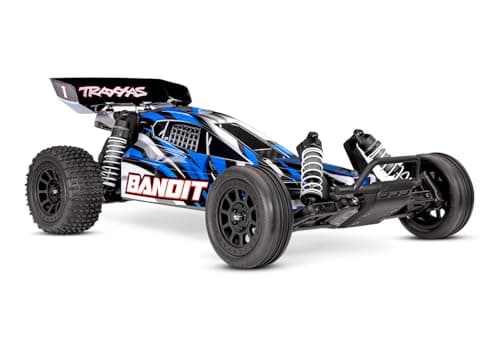 Traxxas Bandit XL-5The lowest, lightest car in the Traxxas 1/10 range, and the cheapest entry to that parts network. | Cheapest way into Traxxas | 8.3 | $219.95View on Amazon #ad — how we earn · price as of November 28, 2026 |
| 2 | 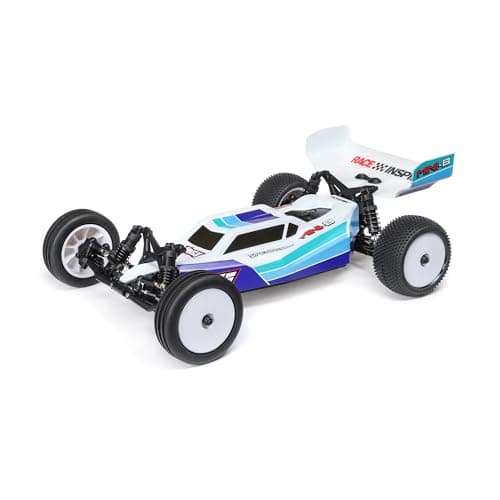 Losi Mini-BA small racing buggy that teaches real car control, because two-wheel drive punishes clumsy throttle. | Learning to drive properly | 8.1 | $229.99View on Amazon #ad — how we earn · price as of November 28, 2026 |
| 3 | 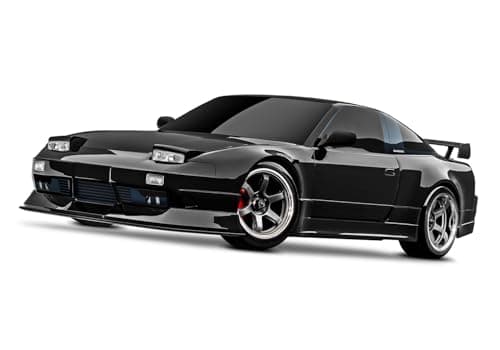 Traxxas 4-Tec DriftA purpose-built rear-wheel-drive drift car that arrives assembled, balanced and with electronic drift assistance already fitted. | Real drifting | 8.3 | $299.95View on Amazon #ad — how we earn · price as of November 28, 2026 |
| 4 | 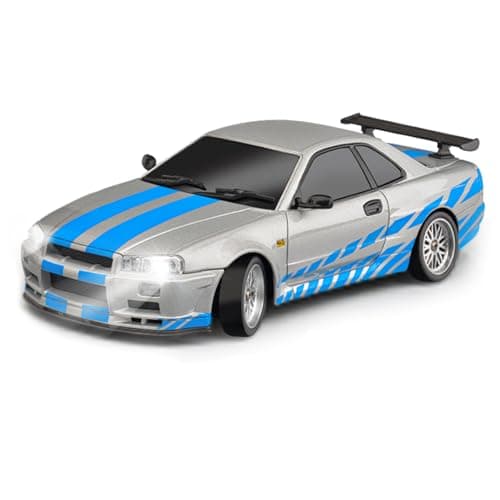 ARRIS LD1899 GTR R34 Drift CarA ready-to-run rear-wheel-drive drift car with a gyro fitted, at a fraction of what a 1/10 drift chassis costs. | Cheaper way into drift | 7.8 | |
| 5 | 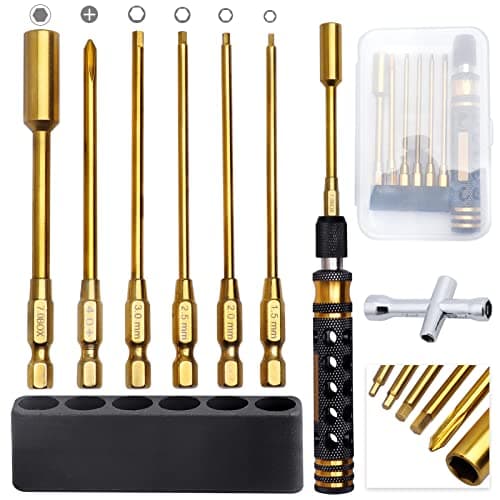 HobbyPark 6-in-1 RC driver setThe L-shaped keys in the box round off after a few uses. A proper driver set is the first upgrade nobody thinks of. | Fixing it yourself | 8.3 | $24.97View on Amazon #ad — how we earn · price as of November 28, 2026 |
Product photo via Amazon.
#1 · Cheapest way into Traxxas
Traxxas Bandit XL-5
The lowest, lightest car in the Traxxas 1/10 range, and the cheapest entry to that parts network.
8.3/10our score for this use
A classic rear-motor two-wheel-drive buggy with a brushed XL-5 speed control. It gives up the all-wheel-drive grip of its siblings and, in exchange, costs less and is more forgiving of crashes because there is less of it to break. The version Amazon stocks ships with an 8.4 volt 3000mAh NiMH pack and a 4-amp USB-C charger, and the XL-5 speed control carries Training Mode as one of its three drive profiles.
- Size:
- 1/10
- Drive:
- 2WD
- Motor:
- brushed motor
What it does well
- The cheapest route into Traxxas parts availability and build quality
- Battery and charger are in the box, so the sticker is the real cost
- Low and light: it survives crashes that bend taller trucks
What it does badly
- Two-wheel drive is hard work in wet grass or loose dirt
- The included pack is NiMH, so the first upgrade most owners make is a LiPo
- Less impressive to look at than a monster truck, which matters with younger children
Specifications from Traxxas' own XL-5 model comparison.
#ad — how we earn · price as of November 28, 2026
Product photo via Amazon.
#2 · Learning to drive properly
Losi Mini-B
A small racing buggy that teaches real car control, because two-wheel drive punishes clumsy throttle.
8.1/10our score for this use
A buggy is the low, wide, open-wheel shape used in off-road racing. The Mini-B is a small, light two-wheel-drive version — the kind of car that rewards smooth inputs and shows you immediately when you were heavy-handed. The version Losi currently sells is the brushless one, which is quick for its size.
- Size:
- 1/16
- Drive:
- 2WD
- Motor:
- brushless motor
What it does well
- Low and wide, so it barely rolls over — the opposite problem to a monster truck
- Teaches throttle and steering control better than a four-wheel-drive car that flatters everyone
- Light enough that crashes rarely break anything
What it does badly
- Two-wheel drive struggles in long grass and loose dirt
- Brushless power in a light two-wheel-drive buggy is a handful for the first few runs
- Small wheels mean small obstacles stop it
Specifications from Losi's mini range.
#ad — how we earn · price as of November 28, 2026
Product photo via Amazon.
#3 · Real drifting
Traxxas 4-Tec Drift
A purpose-built rear-wheel-drive drift car that arrives assembled, balanced and with electronic drift assistance already fitted.
8.3/10our score for this use
Drifting is deliberately sliding the car sideways through a corner. Electronic drift assistance counter-steers faster than a human can, which is what makes a rear-wheel-drive drift car learnable rather than infuriating. Traxxas builds this one as a rear-wheel-drive platform on the 200mm 4-Tec 2.0 chassis, with 75 degrees of steering angle, adjustable caster, roll center, Ackermann and track width, and a licensed Nissan 240SX body with hidden clipless latches. Two sets of 1.9-inch drift tires are included — a hard compound for pavement and a soft one for polished floors — and the TSM drift assistance is tunable from the free Traxxas Link app.
- Size:
- 1/10
- Drive:
- 2WD (rear)
- Motor:
- brushed motor
What it does well
- Designed as a drift car, not adapted from something else — the geometry is right out of the box
- TSM drift assistance is fitted and app-tunable, which is the difference between learning and giving up
- Two tire compounds in the box, so it works on pavement and on a polished indoor floor
What it does badly
- Smooth flat surfaces only: it is useless on grass, gravel or a bumpy driveway
- Drifting takes real practice. A child expecting instant results will be frustrated
- Battery and charger are sold separately, and the drift tires are a consumable
Specifications from the Traxxas 4-Tec Drift product page.
#ad — how we earn · price as of November 28, 2026
Product photo via Amazon.
#4 · Cheaper way into drift
ARRIS LD1899 GTR R34 Drift Car
A ready-to-run rear-wheel-drive drift car with a gyro fitted, at a fraction of what a 1/10 drift chassis costs.
7.8/10our score for this use
A 1:18 rear-wheel-drive drift car with an alloy body styled after the Nissan Skyline GTR R34, sold ready to run with a gyroscopic stabilizer already fitted. Smaller and far cheaper than a 1/10 drift chassis, which makes it the realistic way to find out whether someone enjoys drifting before spending properly.
- Size:
- 1:18
- Drive:
- 2WD (rear)
- Motor:
- brushed motor
What it does well
- Rear-wheel drive and a gyro — the two things that make drifting work — for a fraction of 1/10 money
- Small enough to drift on a kitchen floor, so no venue is needed
- An alloy body rather than the thin polycarbonate at this price
What it does badly
- Smooth surfaces only, like every drift car
- At 1:18 it is a toy-sized car; it will not satisfy someone who has driven a 1/10 drifter
- No real parts network — a broken part means hunting for a listing
Specifications from the ARRIS LD1899 listing.
Product photo via Amazon.
#5 · Fixing it yourself
HobbyPark 6-in-1 RC driver set
The L-shaped keys in the box round off after a few uses. A proper driver set is the first upgrade nobody thinks of.
8.3/10our score for this use
Hobby-grade cars are held together with small hex screws and nuts, and the folded metal keys included in the box are made down to a price. This set is one magnetic aluminum handle plus 1.5, 2.0, 2.5 and 3.0mm hex bits, a 7mm nut driver, a Phillips bit and a small wheel wrench — HobbyPark lists titanium-machined alloy steel bits over 60 hardness, and names Traxxas, Arrma, Axial, Losi, Redcat, HPI and HSP as fits.
What it does well
- Makes repairs quick enough that they actually get done instead of shelving the car
- Hardened bits, so screw heads stop being rounded off by a badly fitting key
- The four hex sizes and the 7mm nut driver cover every brand on this site
What it does badly
- Not an exciting thing to unwrap on its own
- A single handle means swapping bits rather than picking up the next driver
- No metric nut sizes beyond 7mm, so a big 1/8 truck may want one more driver
#ad — how we earn · price as of November 28, 2026
Where to drive a rear-drive car
Surface matters more here than on any four-wheel-drive car, and getting it wrong is the most common reason a 2WD purchase disappoints. Rear drive needs grip under the back wheels to put power down at all. On asphalt, smooth concrete, a tennis court or a hard-packed surface, these cars are quick and precise. On loose dirt, gravel or anything longer than mown grass, the rear wheels spin, the front end pushes wide, and the car simply does not go where it is pointed.
- Asphalt and smooth concrete: ideal for all four picks, and the only sensible surface for the two drift cars. The best RC cars for pavement covers hard surfaces properly.
- Short mown grass: fine for the Bandit and the Mini-B, hopeless for the drift cars.
- Loose dirt or gravel: buy four-wheel drive instead. The best RC cars for dirt ranks that field.
- Indoors on hard floors: the two drift cars are genuinely good at this, and the ARRIS is small enough for a hallway. The best indoor RC cars has the wider list.
- Anywhere near a street: no. Where to drive RC cars is the practical guide.
What a gyro actually does, and why two of these have one
A gyroscopic stabilizer senses the car beginning to rotate and applies counter-steer faster than a human can react. On a drift car that is not a cheat, it is the thing that makes the discipline learnable at all: holding a sustained slide requires corrections at a speed no thumb manages reliably, so without assistance a rear-drive drift car spins and stops, over and over. Both drift picks here arrive with assistance already fitted, which is why they can be recommended to someone who has never drifted.
It is worth knowing that the same device is unhelpful on the buggies. A gyro fighting the back end is exactly the feedback a driver learning throttle control needs to feel, so the Bandit and the Mini-B are better without one. What is a gyro in an RC car explains the hardware, and what is an ESC on an RC car covers the speed control that houses the limiter on the Bandit.
Honest cons, stated once
- The Bandit gives up the all-wheel-drive grip of its siblings, ships with the older NiMH chemistry, and is brushed rather than brushless — it is the cheapest Traxxas 1/10, not the fastest.
- The Mini-B is brushless power in a light rear-drive buggy, which is a handful for the first few runs and not a car to hand to a child without an adult alongside.
- The 4-Tec Drift needs a battery and a charger bought separately, its drift tires are a consumable, and it is useless off a smooth surface.
- The ARRIS is a 1:18 car with no dealer parts network behind it, and the alloy body is styled after a Skyline rather than licensed as one.
- All four put their power through two wheels, which means less traction on every loose surface than any 4WD car on this site.
Which one to buy
- Best 2WD overall: the Traxxas Bandit XL-5 — complete in the box, Training Mode on the radio, and the cheapest entry to the deepest parts catalog in the hobby.
- Learning real car control: the Losi Mini-B, which shows you every clumsy input and sits inside the Horizon Hobby dealer network.
- Drifting properly: the Traxxas 4-Tec Drift, with 75 degrees of steering angle and two sets of tires included.
- The budget pick: the ARRIS LD1899 GTR R34 — a gyro-equipped 1:18 drift car and the cheap way to find out whether drifting sticks.
- Buy alongside any of them: a proper driver set, because a low, light car gets flipped onto its roof more often than it gets broken.
How we ranked these
By setting the criteria first — whether the power is controllable, whether parts exist, what is in the box, which discipline the car is built for, how forgiving the shape is, and which surfaces it suits — then ranking against each manufacturer's own published specifications, which are linked under Sources. Where a maker publishes no figure we left it out rather than estimate it, and every pick's real weakness is stated above as well as on its own card. This page also says plainly that four-wheel drive is the better choice for most first-time buyers, because a list that only sells the layout it is about is not useful. We do not test these products first-hand, we publish no ratings or test results, and nothing here is described as award-winning; our methodology page explains exactly what we do instead. Prices come from the price layer at the moment you load this page.