Guide
How to drive an RC car
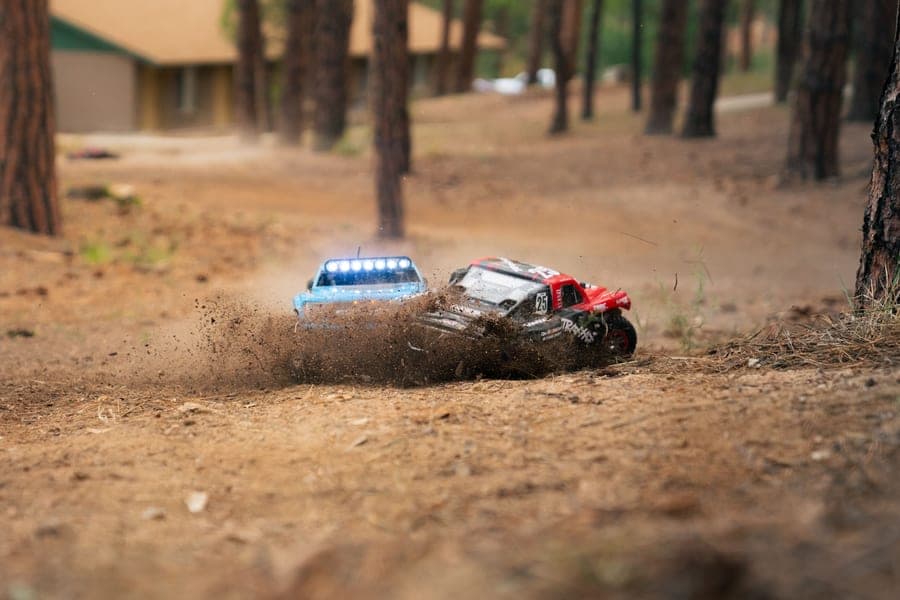
RC cars are easy to move and surprisingly hard to drive well. Nearly all of the difference is throttle discipline, plus one trick for the moment the car is coming towards you.
By Ryder M. · Published October 17, 2026 · Last reviewed
Shock & Servo is reader-supported. If you buy through a link on this page we may earn a commission, at no extra cost to you. It never changes which products we pick or the order we rank them in — the full rules are on our methodology page and our affiliate disclosure.
The single thing that separates a good RC driver from a beginner is how little throttle they use. A beginner squeezes the trigger fully, the car accelerates faster than they can react, and it arrives somewhere unintended at speed. An experienced driver spends almost the whole run between a quarter and half throttle, placing the car, and uses full power only on a straight line with somewhere to stop. Learn that and everything else — cornering, jumping, recovering a slide — follows from it.
Direct answer: hold the car at part throttle, look where you want the car to go rather than at the car, steer before you arrive at the corner rather than during it, and remember that left and right swap over when the car is pointing at you. Start on grass, which grips and forgives, and switch the power limiter on if the car has one.
The first five minutes
- Transmitter on first, car second. Car off first, transmitter second. Doing it the other way round can leave a car briefly looking for a signal it does not have.
- Check the steering trim. With the trigger at neutral and the car on a stand or held up, the front wheels should sit straight. The trim dial corrects them if not.
- Check the car does not creep. At neutral throttle it should stay still. If it inches forward, the throttle trim needs adjusting rather than the car repairing.
- Switch the limiter on if there is one. Traxxas calls it Training Mode; several brands have an equivalent. It is a few seconds of button-holding and it saves the car.
- Drive slowly in a straight line, then a figure of eight. Dull, and the fastest way to learn where the car actually goes.
- Stay within sight. Not range — sight. You cannot steer what you cannot see, and a car behind a hedge is a crash waiting.
The reversed-steering problem
This is the moment every new driver fails. When the car drives away from you, left on the wheel is left on the ground and everything is intuitive. When the car comes back towards you, the car's left is your right, and the controls feel inverted — so the natural correction sends the car exactly the wrong way, usually into something. It is not a fault and it never fully goes away; it becomes automatic with practice.
Two things make it manageable quickly. The first is to steer in the direction you want the car to move *across your field of view*, rather than thinking about the car's own left and right: if you want it to go to your left, steer left. The second is to practice it deliberately — drive the car away, turn it around, and bring it back at walking pace, repeatedly. Ten minutes of that is worth hours of avoiding the situation. It is also the main argument for starting slowly, because at full throttle there is no time to work it out.
What good throttle control looks like
| Situation | What to do | Why |
|---|---|---|
| Approaching a corner | Ease off before, not during | A car braking mid-corner slides straight on |
| Mid-corner | Steady part throttle | Keeps the chassis settled and the tires loaded |
| Exiting a corner | Feed power in progressively | Full throttle unsettles the back end |
| Rear end sliding out | Ease off slightly and steer into the slide | Lifting off completely makes it worse |
| Approaching a jump | Constant throttle, straight and level | Changing throttle in the air changes the landing angle |
| Long grass or a climb | More throttle than feels right | Load needs power; hesitating stalls the car |
Cars that are easy to learn on
| # | Product | Best for | Score | Price |
|---|---|---|---|---|
| 1 | 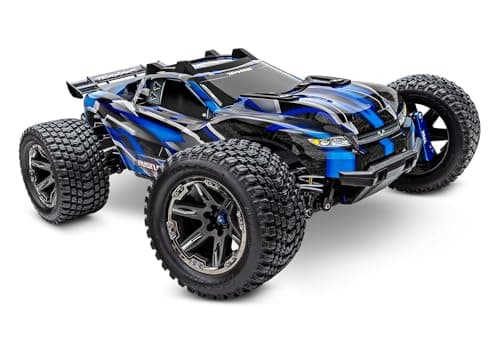 Traxxas Rustler 4X4 VXLVery fast, and the only reason it suits a beginner is the built-in Training Mode that halves the power. | Speed, with a limiter | 8.9 | |
| 2 | 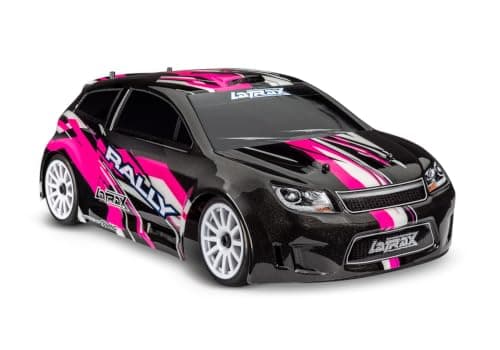 Traxxas LaTrax RallyWaterproof, four-wheel drive, and it comes with a battery and a charger — the friendliest way into the real hobby. | A family's first hobby car | 8.8 | $139.95View on Amazon #ad — how we earn · price as of November 12, 2026 |
| 3 | 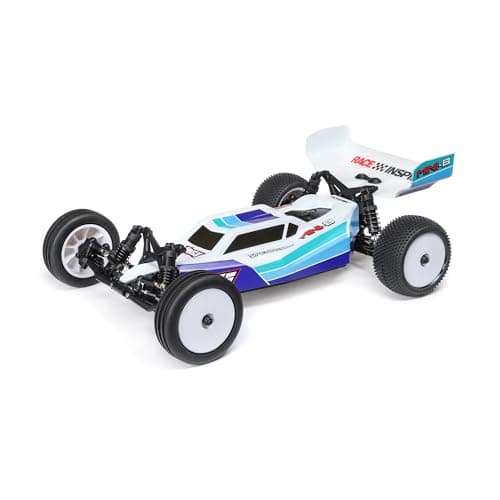 Losi Mini-BA small racing buggy that teaches real car control, because two-wheel drive punishes clumsy throttle. | Learning to drive properly | 8.1 | $229.00View on Amazon #ad — how we earn · price as of November 12, 2026 |
| 4 | 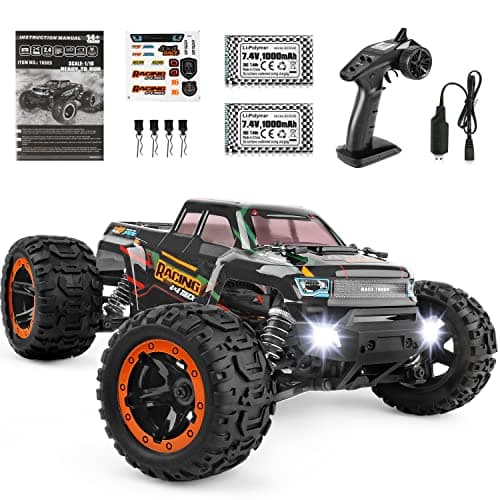 HAIBOXING 16889HAIBOXING calls it hobby class and, unusually at this price, largely means it — ball bearings, four-wheel drive and two batteries in the box. | Bridging toy to hobby | 8.2 | $85.99View on Amazon #ad — how we earn · price as of November 12, 2026 |
Product photo via Amazon.
#1 · Speed, with a limiter
Traxxas Rustler 4X4 VXL
Very fast, and the only reason it suits a beginner is the built-in Training Mode that halves the power.
8.9/10our score for this use
A stadium truck — open wheels, big tires, built to jump. Traxxas states 65+ mph with a 3-cell LiPo and 20/54 gearing, and, crucially, a patented Training Mode on the VXL-3s speed control that cuts throttle and reverse to 50%. You can hand it to a child on the low setting and unlock the rest later. The box Amazon stocks is the Ultimate: factory aluminum caster and steering blocks, axle carriers and chassis stiffener, PTFE-coated aluminum GTR shocks, adjustable sway bars, Gravix tires, a waterproof 2075R metal-gear servo and a Traxxas Link wireless module with telemetry sensors already fitted.
- Size:
- 1/10
- Drive:
- Shaft-driven 4WD
- Motor:
- brushless motor
What it does well
- Training Mode cuts the power in half — a genuine answer to "this is too fast for them"
- The Ultimate arrives with the aluminum parts and GTR shocks most owners buy later anyway
- Traxxas parts support, which is the best in the hobby
What it does badly
- At full power it is a 60-plus mph vehicle. That is not a child's toy, and it needs open space
- No battery or charger included — the real cost is meaningfully higher than the sticker
- Open wheels catch on curbs and fences in a way the Slash's bodywork does not
Specifications from the Traxxas Rustler 4X4 VXL product page.
Product photo via Amazon.
#2 · A family's first hobby car
Traxxas LaTrax Rally
Waterproof, four-wheel drive, and it comes with a battery and a charger — the friendliest way into the real hobby.
8.8/10our score for this use
A 1/18 rally car from Traxxas, meaning it is about half the size of the trucks you see at a track but built by a company with parts in real hobby shops. Traxxas lists waterproof all-weather electronics, a 6-volt NiMH battery and a wall charger in the box, and a speed control with drive profiles that include a training mode.
- Size:
- 1/18
- Drive:
- Shaft-driven 4WD
- Motor:
- brushed motor
What it does well
- Battery and charger are included, so the gift works the day it is opened
- Waterproof electronics — wet grass and puddles are genuinely fine
- A training mode that limits the power, then full power later, so the car grows with the driver
- Traxxas parts are stocked by hobby shops and easy to order
What it does badly
- The NiMH battery it ships with is slower and heavier than a LiPo, so the first upgrade is obvious
- Low-slung rally body grounds out on thick grass — it prefers gravel, dirt and pavement
- Costs noticeably more than the toy-grade cars it sits beside on a search results page
Specifications from the Traxxas LaTrax Rally product page.
#ad — how we earn · price as of November 12, 2026
Product photo via Amazon.
#3 · Learning to drive properly
Losi Mini-B
A small racing buggy that teaches real car control, because two-wheel drive punishes clumsy throttle.
8.1/10our score for this use
A buggy is the low, wide, open-wheel shape used in off-road racing. The Mini-B is a small, light two-wheel-drive version — the kind of car that rewards smooth inputs and shows you immediately when you were heavy-handed. The version Losi currently sells is the brushless one, which is quick for its size.
- Size:
- 1/16
- Drive:
- 2WD
- Motor:
- brushless motor
What it does well
- Low and wide, so it barely rolls over — the opposite problem to a monster truck
- Teaches throttle and steering control better than a four-wheel-drive car that flatters everyone
- Light enough that crashes rarely break anything
What it does badly
- Two-wheel drive struggles in long grass and loose dirt
- Brushless power in a light two-wheel-drive buggy is a handful for the first few runs
- Small wheels mean small obstacles stop it
Specifications from Losi's mini range.
#ad — how we earn · price as of November 12, 2026
Product photo via Amazon.
#4 · Bridging toy to hobby
HAIBOXING 16889
HAIBOXING calls it hobby class and, unusually at this price, largely means it — ball bearings, four-wheel drive and two batteries in the box.
8.2/10our score for this use
A 1:16 truck, so roughly the size of a shoebox. HAIBOXING states a top speed above 36 km/h — around 22 mph — from an RC390 brushed motor, with four-wheel drive, ball bearings throughout, independent coil-sprung suspension on each wheel and splash-proof electronics. Two 1000mAh packs come in the box for 20 to 40 minutes of driving, and the transmitter has a speed switch for a beginner.
- Size:
- 1:16
- Drive:
- 4WD
- Motor:
- brushed motor
What it does well
- Real four-wheel drive, ball bearings and independent suspension at a price that usually buys none of them
- Two batteries in the box, which is the difference between a long afternoon and a short one
- Every part carries a number in the manual and can be ordered separately — most toy brands offer nothing
What it does badly
- Parts are HAIBOXING-only — nothing sits on the shelf at a local hobby shop
- Quick enough to break things, and the plastic is not Traxxas plastic
- The steering servo is the usual weak point at this price
Specifications from the HAIBOXING 16889 listing specification.
#ad — how we earn · price as of November 12, 2026
Pick the surface before the car
Grass is the best place to learn and it is not close. It grips, it slows the car down naturally, it absorbs a crash, and there is usually nothing hard nearby to hit. Tarmac is the worst: the car is faster, the slides are longer, and everything around a car park is made of concrete. Dirt is somewhere in between and gets more interesting as the driver improves. A new driver who starts on a lawn will be competent on tarmac within a few sessions; one who starts on tarmac will have broken something first.
Space matters as much as surface. A beginner in a small garden spends the whole run avoiding the fence, which teaches nothing and breaks things; a beginner on a school field at the weekend has room to get it wrong harmlessly. If space is the constraint, the answer is a smaller car rather than more caution — the best RC cars for a backyard covers sizing to the space, and where to drive RC cars covers finding somewhere better.
Four habits worth building early
- Look ahead, not at the car. Watching the car means reacting to where it has been. Watching where it is going means steering before you need to.
- Stop before the battery is flat. A LiPo run completely empty loses capacity permanently. When the car noticeably slows, that is the signal.
- Check the screws every few runs. Vibration backs them out, and a loose shock tower or motor mount damages whatever is next to it.
- Clear the grass out afterwards. Grit and grass in the drivetrain is what turns ordinary wear into damage. How to clean an RC car covers it.
How we assembled this guide
The driving principles above are the standard technique for a proportional-control electric RC car, and the setup steps — power-on order, steering and throttle trim, and enabling a power limiter — follow the manufacturer documentation linked in Sources, including Traxxas' own description of Training Mode on the models that carry it. We have not estimated any figure on this page and no measurement here is ours. Prices are never written into our copy: every figure shown is read from Amazon that day and rendered inside the buy button, with the date it was read. We do not test these products first-hand; our methodology page explains what that means for an instructional guide.