Guide
Do RC cars have brakes?
RC cars have no brake discs, no pads and no hydraulics, and they still stop hard. The motor does the work, which explains several things that confuse new drivers.
By Ryder M. · Published October 17, 2026 · Last reviewed
Shock & Servo is reader-supported. If you buy through a link on this page we may earn a commission, at no extra cost to you. It never changes which products we pick or the order we rank them in — the full rules are on our methodology page and our affiliate disclosure.
Yes — almost every electric RC car has brakes, and they work through the motor rather than through anything you can see. Push the transmitter trigger forward from neutral and the speed control connects the motor's windings together, which turns the spinning motor into a generator fighting its own rotation. That drag is the brake. It is strong, instant, completely silent and has no parts to wear out, which is why there is nothing resembling a brake disc anywhere on the chassis.
Direct answer: electric RC cars brake electronically, using the drive motor itself. Nitro and gas cars are the exception — they have a real mechanical disc brake on the drivetrain, operated by a second servo, because an idling engine cannot provide braking the way an electric motor can.
How electronic braking actually works
A spinning electric motor generates a voltage. If you connect its terminals together, that generated current flows and produces a force opposing the rotation — the motor becomes very hard to turn. An electronic speed control brakes by doing exactly that, rapidly switching the motor's windings into a short circuit and controlling how much of the time it does so. A light trigger push gives a gentle brake; a full push gives as much as the system can produce. The energy ends up as heat in the motor and the speed control, which is why both get warm.
This is the same principle as the regenerative braking on a full-size electric car, with one difference: an RC speed control usually dumps that energy as heat rather than putting it back into the pack. The practical consequences are all good — nothing to adjust mechanically, nothing to wear out, and a brake that is available instantly and in proportion. What is an ESC on an RC car covers the rest of what that component does.
Why reverse needs two pushes
This is the question behind the question, and it catches almost every new driver. On a car with reverse, the same trigger direction is used for braking and reversing — so the speed control has to tell them apart. It does so with a sequence: the first push brakes, and only when the car has stopped and the trigger has returned to neutral does a second push engage reverse. Push, release, push. If reverse seems broken, it is nearly always because the trigger never returned to neutral in between.
Some cars let you change this. Many speed controls offer a forward-and-brake-only mode, which disables reverse entirely and gives a more aggressive brake — the setting racers use, since nobody reverses on a track. Others offer a crawler mode with instant reverse and no braking delay, which is what you want for inching off a rock. The manual lists which modes the car has and how to switch between them, and it is usually a matter of holding a button while powering up.
What you can adjust
| Setting | What it changes | When to touch it |
|---|---|---|
| Brake strength | How hard full brake bites | Turn it down for a beginner or a slippery surface |
| Drag brake | Automatic braking at neutral throttle | Up for crawling, off for bashing and speed |
| Forward/brake only | Disables reverse, frees up full brake | Racing, or to stop a child reversing into things |
| Neutral deadband | How far the trigger moves before anything happens | If the car creeps at rest |
| Throttle trim | Where the speed control thinks neutral is | First thing to check if the car creeps or will not stop |
Cars where braking is worth paying attention to
| # | Product | Best for | Score | Price |
|---|---|---|---|---|
| 1 | 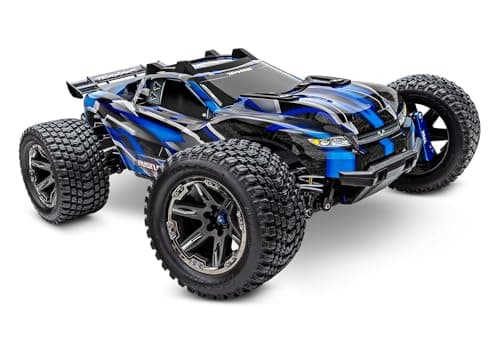 Traxxas Rustler 4X4 VXLVery fast, and the only reason it suits a beginner is the built-in Training Mode that halves the power. | Speed, with a limiter | 8.9 | |
| 2 | 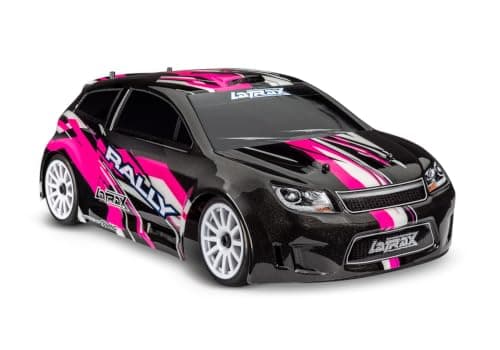 Traxxas LaTrax RallyWaterproof, four-wheel drive, and it comes with a battery and a charger — the friendliest way into the real hobby. | A family's first hobby car | 8.8 | $139.95View on Amazon #ad — how we earn · price as of November 12, 2026 |
| 3 | 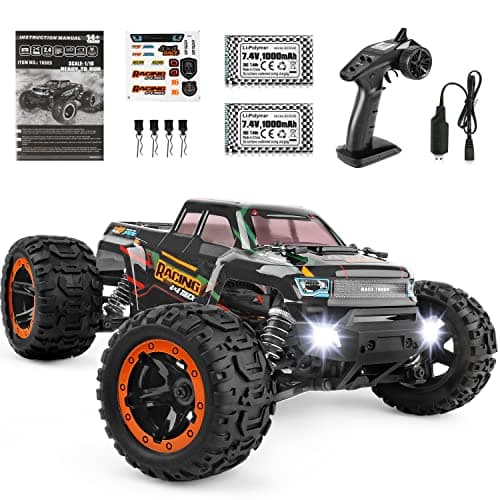 HAIBOXING 16889HAIBOXING calls it hobby class and, unusually at this price, largely means it — ball bearings, four-wheel drive and two batteries in the box. | Bridging toy to hobby | 8.2 | $85.99View on Amazon #ad — how we earn · price as of November 12, 2026 |
Product photo via Amazon.
#1 · Speed, with a limiter
Traxxas Rustler 4X4 VXL
Very fast, and the only reason it suits a beginner is the built-in Training Mode that halves the power.
8.9/10our score for this use
A stadium truck — open wheels, big tires, built to jump. Traxxas states 65+ mph with a 3-cell LiPo and 20/54 gearing, and, crucially, a patented Training Mode on the VXL-3s speed control that cuts throttle and reverse to 50%. You can hand it to a child on the low setting and unlock the rest later. The box Amazon stocks is the Ultimate: factory aluminum caster and steering blocks, axle carriers and chassis stiffener, PTFE-coated aluminum GTR shocks, adjustable sway bars, Gravix tires, a waterproof 2075R metal-gear servo and a Traxxas Link wireless module with telemetry sensors already fitted.
- Size:
- 1/10
- Drive:
- Shaft-driven 4WD
- Motor:
- brushless motor
What it does well
- Training Mode cuts the power in half — a genuine answer to "this is too fast for them"
- The Ultimate arrives with the aluminum parts and GTR shocks most owners buy later anyway
- Traxxas parts support, which is the best in the hobby
What it does badly
- At full power it is a 60-plus mph vehicle. That is not a child's toy, and it needs open space
- No battery or charger included — the real cost is meaningfully higher than the sticker
- Open wheels catch on curbs and fences in a way the Slash's bodywork does not
Specifications from the Traxxas Rustler 4X4 VXL product page.
Product photo via Amazon.
#2 · A family's first hobby car
Traxxas LaTrax Rally
Waterproof, four-wheel drive, and it comes with a battery and a charger — the friendliest way into the real hobby.
8.8/10our score for this use
A 1/18 rally car from Traxxas, meaning it is about half the size of the trucks you see at a track but built by a company with parts in real hobby shops. Traxxas lists waterproof all-weather electronics, a 6-volt NiMH battery and a wall charger in the box, and a speed control with drive profiles that include a training mode.
- Size:
- 1/18
- Drive:
- Shaft-driven 4WD
- Motor:
- brushed motor
What it does well
- Battery and charger are included, so the gift works the day it is opened
- Waterproof electronics — wet grass and puddles are genuinely fine
- A training mode that limits the power, then full power later, so the car grows with the driver
- Traxxas parts are stocked by hobby shops and easy to order
What it does badly
- The NiMH battery it ships with is slower and heavier than a LiPo, so the first upgrade is obvious
- Low-slung rally body grounds out on thick grass — it prefers gravel, dirt and pavement
- Costs noticeably more than the toy-grade cars it sits beside on a search results page
Specifications from the Traxxas LaTrax Rally product page.
#ad — how we earn · price as of November 12, 2026
Product photo via Amazon.
#3 · Bridging toy to hobby
HAIBOXING 16889
HAIBOXING calls it hobby class and, unusually at this price, largely means it — ball bearings, four-wheel drive and two batteries in the box.
8.2/10our score for this use
A 1:16 truck, so roughly the size of a shoebox. HAIBOXING states a top speed above 36 km/h — around 22 mph — from an RC390 brushed motor, with four-wheel drive, ball bearings throughout, independent coil-sprung suspension on each wheel and splash-proof electronics. Two 1000mAh packs come in the box for 20 to 40 minutes of driving, and the transmitter has a speed switch for a beginner.
- Size:
- 1:16
- Drive:
- 4WD
- Motor:
- brushed motor
What it does well
- Real four-wheel drive, ball bearings and independent suspension at a price that usually buys none of them
- Two batteries in the box, which is the difference between a long afternoon and a short one
- Every part carries a number in the manual and can be ordered separately — most toy brands offer nothing
What it does badly
- Parts are HAIBOXING-only — nothing sits on the shelf at a local hobby shop
- Quick enough to break things, and the plastic is not Traxxas plastic
- The steering servo is the usual weak point at this price
Specifications from the HAIBOXING 16889 listing specification.
#ad — how we earn · price as of November 12, 2026
Brakes on toy-grade cars
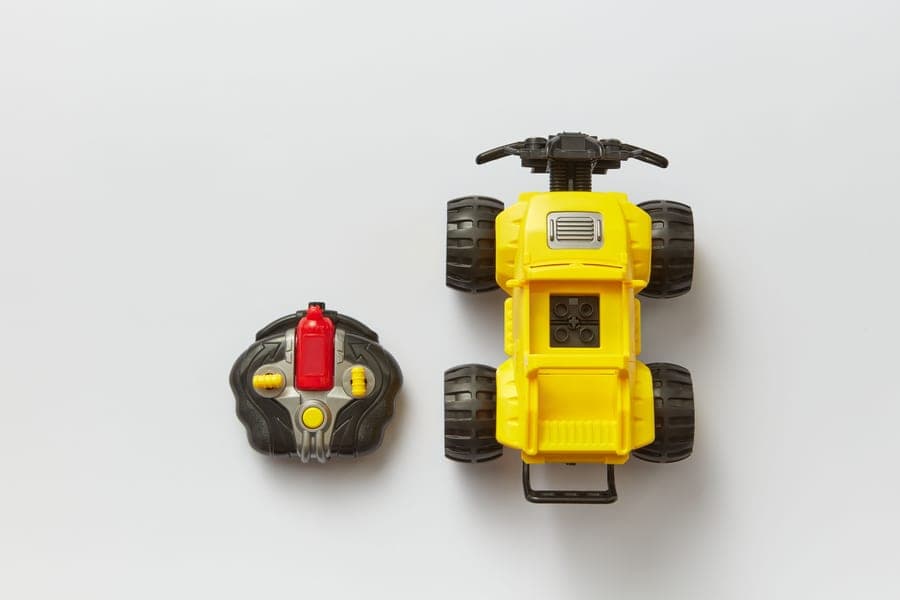
The mechanism is the same in principle but much blunter in practice. A toy-grade car's combined receiver and speed control board typically has only a few throttle states rather than a continuously variable one, so braking is more of an on-off event: release the control and the car coasts, push the other way and it brakes abruptly or simply reverses. It stops the car, which is all it needs to do, but a driver moving up to a hobby-grade car will immediately notice how much more controllable proportional braking is.
The other difference is the drag brake. Hobby-grade speed controls can be set to apply a little braking whenever the throttle is at neutral, so the car slows itself gently instead of freewheeling. On a crawler that is close to essential — it stops the car rolling back down a slope. On a toy car there is usually no such setting, which is part of why a lightweight toy-grade car can feel like it never quite stops where you wanted it to.
Nitro and gas cars are genuinely different
A fuel-burning RC car cannot brake through its engine, because an engine at idle is disconnected from the wheels by a centrifugal clutch. So nitro cars have an actual mechanical brake: a small disc on the drivetrain with a pad squeezed against it by a linkage, operated by the same servo that works the throttle — pull the trigger and the throttle opens, push it and the brake comes on. It works well and it wears out, which means it is one more thing to inspect and adjust. Nitro vs electric RC cars covers the broader trade.
How we assembled this guide
The mechanism described above is the standard behavior of a hobby-grade electronic speed control — braking by shorting the motor windings, the brake-neutral-reverse sequence, and the configurable drag brake and forward-only modes — confirmed against the manufacturer documentation linked in Sources. We have not estimated any figure on this page. Prices are never written into our copy: every figure shown is read from Amazon that day and rendered inside the buy button, with the date it was read. We do not test these products first-hand, and our methodology page explains what that means for an explanatory guide.