Comparison
RC car vs drone
These two land on the same shortlist constantly, and they are not close to equivalent. One has federal paperwork, a fifteen-minute flight time and a crash that is unrepairable; the other does not.
By Ryder M. · Published October 17, 2026 · Last reviewed
Shock & Servo is reader-supported. If you buy through a link on this page we may earn a commission, at no extra cost to you. It never changes which products we pick or the order we rank them in — the full rules are on our methodology page and our affiliate disclosure.
For most people buying a gift, an RC car is the better choice — and the deciding factors are repairability and friction rather than fun. A crashed car breaks a part you can buy; a crashed drone frequently breaks a motor arm, a gimbal or the whole aircraft, and a drone that lands in a tree or a river is simply gone. On top of that, a recreational drone flyer in the United States has to register the aircraft with the FAA and pass the free TRUST test before flying, which is genuine paperwork standing between the box being opened and anything happening. An RC car needs no license at all.
Direct answer: buy the drone if the point is the view from above — aerial photography is something a car genuinely cannot do. Buy the car for almost everything else, and especially for a child, for repeated use, and for anybody who will crash it. If the appeal was specifically the camera, a camera RC car gets most of the way for much less risk.
The comparison, honestly
| RC car | Drone | |
|---|---|---|
| Paperwork before first use | None | FAA registration plus the free TRUST test |
| Typical run time | 15-25 minutes per pack | Usually under 20 minutes per pack |
| What a crash costs | A suspension arm, minutes to fit | Often a motor, an arm or the aircraft |
| Can it be lost? | No | Yes — trees, roofs, water, wind |
| Where it can be used | Yards, car parks, tracks, indoors | Open space, away from airports and crowds |
| Skill before it is fun | Minutes | Hours, and mistakes are expensive |
| Does it have a camera? | On some models | Essentially the point |
| Age it suits from | About 3, with the right model | Realistically teens and up |
The crash is the whole argument
Both of these get crashed, constantly, and that is normal. The difference is what happens next. An RC car hits something at ground level, breaks a plastic suspension arm designed to break first, and is repaired for the price of a coffee once a replacement arrives — on a well-supported platform, that afternoon. A drone that catches a branch falls from height onto whatever is below, and the parts that take the impact are motors, arms and camera mounts, all of which are expensive and some of which are not sold separately at the budget end of the market.
Then there is the failure mode a car does not have: loss. A drone that drifts out of range, loses its link or runs its battery down over water does not come back. Beginner flyers lose aircraft regularly, and no amount of care fully removes the possibility, because wind is involved. An RC car at worst sits in long grass until you walk over and pick it up. For a gift to a child, that asymmetry is close to decisive.
What the drone is genuinely better at
- The view. Aerial footage of a coastline or a hillside is not something a car can approximate. If that is the appeal, nothing else will do.
- Novelty for an adult who has everything. A drone is still impressive in a way a car is not, at least for the first few flights.
- Covering ground. A drone crosses terrain a car cannot — water, fences, deep undergrowth.
- A specific hobby path. Photography, FPV racing and mapping are all real pursuits with real communities behind them.
- Not needing a surface. A drone works over a field, a lake or a forest; a car needs ground it can actually drive on.
The middle option: a car with a camera
| # | Product | Best for | Score | Price |
|---|---|---|---|---|
| 1 | 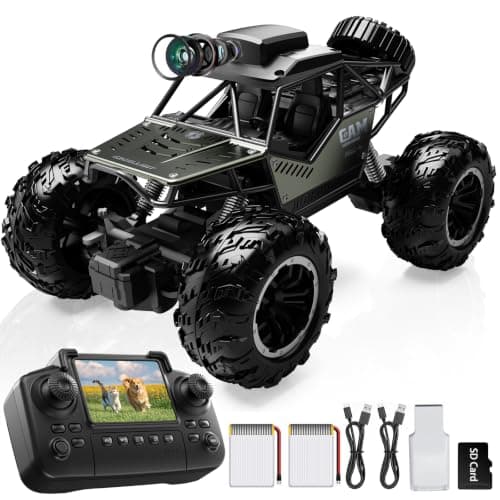 A 1:18 FPV camera truck with a screen remoteA 1:18 off-road truck with a camera on the front and the screen built into the controller — no phone, no app. | A camera on a budget | 7.6 | $79.99View on Amazon #ad — how we earn · price as of November 12, 2026 |
| 2 | 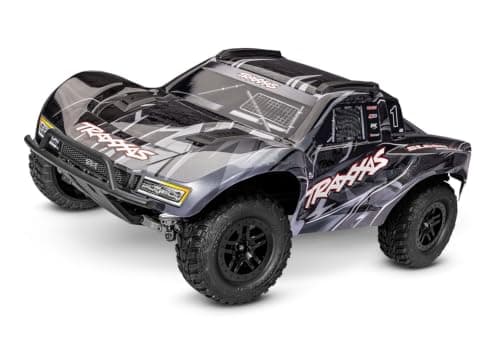 Traxxas Slash 4X4 BL-2sThe short-course truck that half the hobby owns, which is exactly why parts are never a problem. | The safest big gift | 9.1 | $429.95View on Amazon #ad — how we earn · price as of November 12, 2026 |
| 3 | 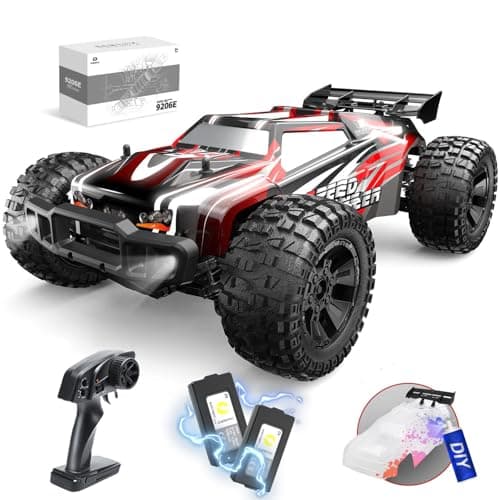 DEERC 9206E 1:10 Monster TruckA full 1:10-size truck at a price that usually buys something half the size — and two batteries again. | A big truck, small money | 8.0 | $104.98View on Amazon #ad — how we earn · price as of November 12, 2026 |
| 4 | 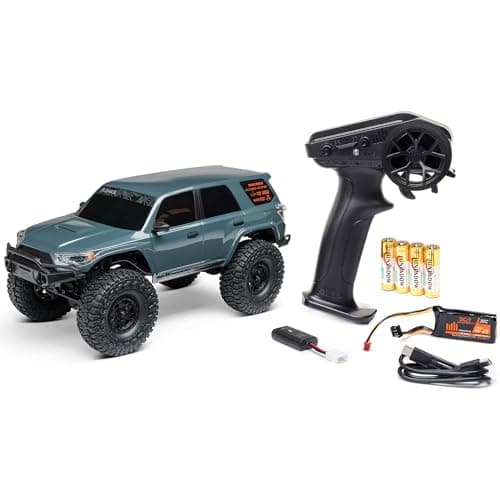 Axial SCX24Under eight inches long, four-wheel drive, and it turns a living room floor into a trail. | Indoor crawling | 8.6 | $159.99View on Amazon #ad — how we earn · price as of November 12, 2026 |
Product photo via Amazon.
#1 · A camera on a budget
A 1:18 FPV camera truck with a screen remote
A 1:18 off-road truck with a camera on the front and the screen built into the controller — no phone, no app.
7.6/10our score for this use
A camera car streams what the car sees onto a screen so you can drive from the car's point of view. This one puts the screen in the transmitter itself, so there is no phone to pair and no app to download, and an SD card is included so photos and video can be played back on the spot. The listing describes an alloy body, off-road tires, independent suspension, a reinforced front bumper, a 2.4GHz radio and two batteries for about 40 minutes.
- Size:
- 1:18
- Drive:
- 4WD
- Motor:
- toy-grade motor
What it does well
- The screen is in the controller, so there is nothing to pair and nothing to install
- Two batteries included, which roughly doubles the useful life of an afternoon
- An alloy body and independent suspension rather than the bare plastic at this price
What it does badly
- Camera video lags behind reality slightly — enough that you crash if you drive by screen alone
- Toy-grade: the camera and the body are not repairable in the way a hobby-grade car is
- The camera is fixed, so you cannot aim it at the ground or the horizon
Specifications from the listing for this camera truck.
#ad — how we earn · price as of November 12, 2026
Product photo via Amazon.
#2 · The safest big gift
Traxxas Slash 4X4 BL-2s
The short-course truck that half the hobby owns, which is exactly why parts are never a problem.
9.1/10our score for this use
A short-course truck is the enclosed-wheel, pickup-bodied shape used in desert racing: the bodywork covers the wheels, so it survives contact far better than an open-wheel buggy. The BL-2s version is brushless and runs on a 2-cell LiPo or a 6-7 cell NiMH battery.
- Size:
- 1/10
- Drive:
- Shaft-driven 4WD
- Motor:
- brushless motor
What it does well
- Enclosed wheels make it the most crash-tolerant shape in the hobby for a beginner
- Traxxas parts are stocked in hobby shops across the country and ship next day online
- A settled, decade-old platform: every part, upgrade and how-to video already exists
What it does badly
- Traxxas lists no battery and no charger in the box, so budget for both before it can be driven
- The total spend climbs well above the sticker once a battery and charger are added
- Fast enough that a first-timer should start in the reduced-power mode, not at full throttle
Specifications from the Traxxas Slash 4X4 BL-2s product page.
#ad — how we earn · price as of November 12, 2026
Product photo via Amazon.
#3 · A big truck, small money
DEERC 9206E 1:10 Monster Truck
A full 1:10-size truck at a price that usually buys something half the size — and two batteries again.
8.0/10our score for this use
1:10 is the size most hobby cars are: roughly 17 to 20 inches long, big enough to see across a yard and heavy enough that grass does not throw it around. DEERC quotes around 48 km/h — roughly 30 mph — and includes two batteries.
- Size:
- 1:10 (about 17-20 inches long)
- Drive:
- 4WD
- Motor:
- toy-grade motor
What it does well
- Proper 1:10 size, so it works on real ground instead of only on a driveway
- Two 7.4 volt 1500mAh batteries in the box, around 40 minutes of combined run time, plus a spare body shell
- Some versions include a second body shell
What it does badly
- Not hobby-grade: spares are DEERC-only and thinner than Traxxas or Arrma
- Heavy for its build quality — a bad landing bends parts a hobby chassis would shrug off
- The stock tires wear quickly on asphalt
Specifications from DEERC's own store listing.
#ad — how we earn · price as of November 12, 2026
Product photo via Amazon.
#4 · Indoor crawling
Axial SCX24
Under eight inches long, four-wheel drive, and it turns a living room floor into a trail.
8.6/10our score for this use
A 1/24 scale crawler — smaller than a shoe — sold under several licensed bodies, including the Toyota 4Runner stocked here plus Jeep, Chevrolet C10 and Dodge Power Wagon versions. It is a complete ready-to-run package with a Spektrum radio, a LiPo battery and a charger included, and it crawls over table legs, stairs and garden rockeries at walking pace.
- Size:
- 1/24 (8-9 inches, depending on body)
- Drive:
- Full-time 4WD
- Motor:
- brushed motor
What it does well
- Small enough to use indoors year-round, which no other hobby-grade car on this site can claim
- Slow, so crashes barely exist — the failure mode is tipping over, not breaking
- A huge aftermarket of upgrade parts if the hobby sticks
What it does badly
- Tiny. If the person you are buying for wanted something impressive to look at, this is not it
- Not fast, and it never will be
- The included battery is small, so a spare pack is an obvious early purchase
Specifications from Axial's own brand site.
#ad — how we earn · price as of November 12, 2026
Why a camera car is the answer more often than people expect
A good proportion of people choosing between these two are really choosing between "a thing that drives" and "a thing with a camera", and the second of those is available without any of the drone's drawbacks. A camera RC car streams a live picture to a screen on the transmitter, which gives a child the same first-person thrill — being somewhere the car is — for a fraction of the money, with no registration, no test, no height, and nothing that can be lost in a tree. The footage is modest rather than cinematic, and judged as a toy camera rather than a camera it is genuinely good fun.
The alternative is a real action camera on a capable car, which produces much better video and costs more. Both routes are covered on the best RC cars with a camera, which sets out where the picture quality actually lands on each. Neither will replace a drone for landscape photography, and both comfortably beat one as a gift for a nine-year-old.
If you are buying for somebody who already has one
An RC car is a good gift for a drone owner and vice versa, because the two scratch different itches and share almost nothing. The one piece of crossover worth knowing is the battery: both use LiPo packs, both benefit from a decent multi-chemistry charger, and a drone owner probably already has one — which removes a purchase from the car side of the ledger. The best RC battery chargers covers chargers that handle both.
If the recipient has neither and you cannot decide, the tiebreaker is where they live. Somebody with open countryside nearby and patience can make a drone work. Somebody with a garden, a driveway or a car park will get far more hours out of a car, and will still have it in two years. Is an RC car a good gift is the page that works that question through properly.
How we assembled this comparison
The regulatory difference above — FAA registration and the free TRUST test for recreational drone flyers, versus no license requirement for an RC car — comes from the FAA's own recreational flyers page, retrieved on 2026-10-17 and linked in Sources. The RC car specifications are from each manufacturer's published product page, also linked. Run times are stated as typical ranges rather than as claims about a specific model, and we have not invented a figure for any drone. Prices are never written into our copy: every figure shown is read from Amazon that day and rendered inside the buy button. We do not test these products first-hand, and we do not sell or recommend drones; our methodology page explains what that means.