Guide
Can you take an RC car on a plane?
The car is the easy part. The batteries are the part with real rules attached, and they are federal rather than up to the airline's mood on the day.
By Ryder M. · Published October 17, 2026 · Last reviewed
Shock & Servo is reader-supported. If you buy through a link on this page we may earn a commission, at no extra cost to you. It never changes which products we pick or the order we rank them in — the full rules are on our methodology page and our affiliate disclosure.
Yes — you can fly with an RC car, and the batteries are the only genuinely regulated part of it. The U.S. Federal Aviation Administration requires that spare, uninstalled lithium batteries travel in carry-on baggage only, never in checked baggage, with their terminals protected against short circuit. Rechargeable lithium-ion packs are limited to a rating of 100 watt hours each; packs rated 101 to 160 watt hours need the airline's approval and are capped at two spares per passenger. The car itself is just an awkwardly shaped object.
Direct answer: car in the hold if you like, batteries in your hand luggage — always. Protect the terminals with tape, a case or the retail packaging, keep every pack with you in the cabin, and check your pack's watt-hour rating against the 100 Wh limit. The rating is volts multiplied by amp-hours, and newer packs print it on the label.
What the FAA actually says
| Item | Carry-on | Checked |
|---|---|---|
| Spare lithium-ion packs (uninstalled) | Yes — required | No |
| Packs up to 100 Wh | Yes, no quantity limit for personal use | No |
| Packs 101-160 Wh | With airline approval, max two spares | No |
| Damaged, swollen or recalled packs | No | No |
| The car, transmitter and charger | Either | Either |
| A pack installed in a device | Either, per the device rules | Check the airline |
Working out whether your pack is under 100 Wh
Watt hours are volts multiplied by amp-hours, and the FAA says so explicitly on its own guidance page. A typical 2S LiPo is rated 7.4 volts; a 3S is 11.1 volts. Multiply by the pack's capacity converted from milliamp-hours into amp-hours — so a 5000 mAh pack is 5 amp-hours. The arithmetic puts ordinary RC car packs comfortably inside the limit: the large ones used in 1/8 scale bashers are the only ones that come close, and newer packs print the watt-hour figure on the label so you do not have to calculate anything. If a pack has no marking and you cannot work it out, assume the airline will ask.
The terminal-protection requirement is the one people forget, and it is the one with an obvious physical reason behind it: a loose pack rattling against keys or a metal water bottle can short, and a shorted LiPo can vent or burn. Tape over the plug, leave packs in their retail boxes, or put each one in its own bag. A fireproof charging bag does the job neatly and is useful at the other end too. How to store LiPo batteries covers the same handling rules for home.
Packing the car itself
- Take the battery out and keep it with you. This is the rule, and it also stops the car switching itself on in a bag.
- Take the wheels off if the car is large. Four screws, and it transforms how a 1/10 truck fits into a case.
- Protect the body and the shock towers. They are the parts that snap under a suitcase, not the chassis.
- Pack the transmitter with its own cells removed. A trigger pressed inside a bag drains them completely.
- Bring the charger and its cable. A charger is not a battery for these purposes and can travel in either bag.
- Keep spares and tools together. A hex driver in checked baggage avoids any question about tools in the cabin.
What to pack it with
| # | Product | Best for | Score | Price |
|---|---|---|---|---|
| 1 | 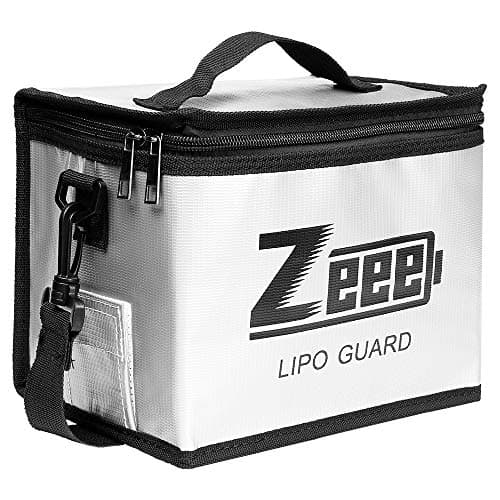 Zeee fireproof LiPo charging bagThe cheapest sensible thing you can add to any gift that includes a LiPo battery. | Charging safely | 8.5 | $12.74$13.49(6% off)View on Amazon #ad — how we earn · price as of November 12, 2026 |
| 2 | 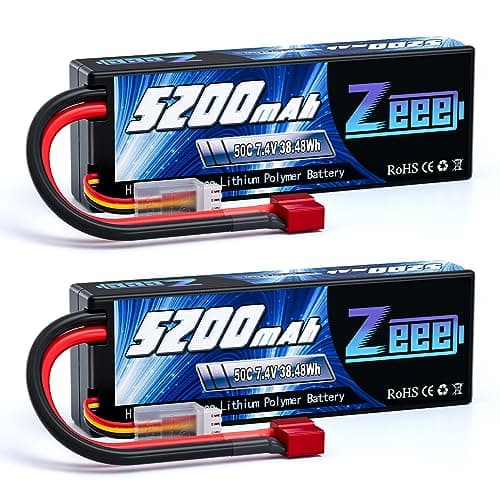 Zeee 2S LiPo batterySold in twos for about what one premium pack costs — the reason so many garages have a stack of them. | Two packs, low spend | 8.1 | $35.08$38.98(10% off)View on Amazon #ad — how we earn · price as of November 12, 2026 |
| 3 | 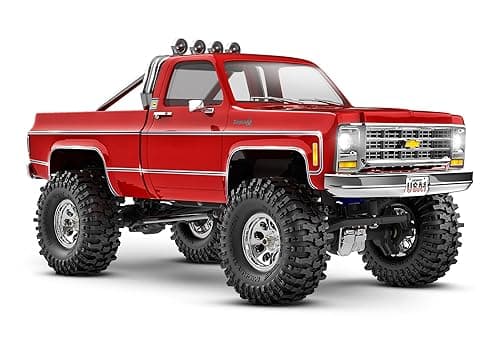 Traxxas TRX-4MThe small Traxxas crawler that arrives complete: battery, charger, waterproof electronics and a licensed body. | Crawling, complete in box | 9.0 | $199.95View on Amazon #ad — how we earn · price as of November 12, 2026 |
| 4 | 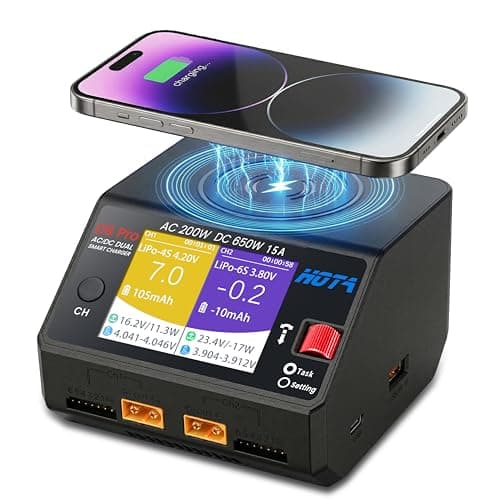 HOTA D6 Pro chargerTwo channels, plugs straight into the wall, and fast enough that charging stops being the bottleneck. | The one to buy once | 8.8 | $109.99$119.99(8% off)View on Amazon #ad — how we earn · price as of November 12, 2026 |
Product photo via Amazon.
#1 · Charging safely
Zeee fireproof LiPo charging bag
The cheapest sensible thing you can add to any gift that includes a LiPo battery.
8.5/10our score for this use
A fire-resistant pouch that the battery sits inside while it charges. LiPo batteries very rarely fail, but when they do they do it energetically, and every experienced owner charges inside a bag or a metal tin. Zeee lists a fireproof inner fabric, a flame-retardant interlayer and a PVC outer, rated to insulate up to 1000 degrees Fahrenheit, in a 8.5 x 6.5 x 5.7 inch bag big enough for a stack of packs.
What it does well
- Costs very little and reduces the one genuine hazard in this hobby
- Doubles as somewhere to store and carry packs between uses
- Fits any battery, any brand
What it does badly
- Not a magic shield — Zeee itself says the bag cannot contain a fire above 1000 degrees Fahrenheit, and a charging battery still needs to be attended
- The cheap ones have flimsy zips
- One more thing to remember to use
#ad — how we earn · price as of November 12, 2026
Product photo via Amazon.
#2 · Two packs, low spend
Zeee 2S LiPo battery
Sold in twos for about what one premium pack costs — the reason so many garages have a stack of them.
8.1/10our score for this use
The budget end of the LiPo market, usually sold as a two-pack. For a gift where the goal is more driving time rather than maximum performance, two adequate batteries beat one excellent one.
What it does well
- Two-packs at a price that makes a spare battery an easy decision
- Perfectly adequate for bashing, which is what most of these cars do
- Widely stocked in the common sizes
What it does badly
- Pack-to-pack consistency is not at the level of the premium brands
- They tend to age faster if they are stored fully charged — which beginners do
- Not the choice for racing
#ad — how we earn · price as of November 12, 2026
Product photo via Amazon.
#3 · Crawling, complete in box
Traxxas TRX-4M
The small Traxxas crawler that arrives complete: battery, charger, waterproof electronics and a licensed body.
9.0/10our score for this use
A 1/18 scale trail crawler eleven inches long, built on a steel ladder frame with solid axles and a four-link suspension — the layout of a real truck, shrunk. Traxxas fits its waterproof ECM-2.5 module with Sport, Trail and Crawl modes, and the box includes a 7.4 volt 750mAh LiPo and a 2-amp USB charger, so nothing else is needed on the day. It is sold under several licensed bodies; the one stocked here wears a 1979 Chevrolet K10 truck body.
- Size:
- 1/18 (11 inches long)
- Drive:
- Solid-axle 4WD
- Motor:
- brushed motor
What it does well
- Battery and USB charger are in the box, which almost nothing else in the Traxxas range can say
- Waterproof electronics and LED lights, so wet grass and after-dark driving are both fine
- Small enough for a living room, a rockery or a stack of books — no field required
What it does badly
- Crawlers are slow by design. If the recipient wants speed, this is the wrong shape entirely
- The 750mAh pack is small; a second battery is the first thing most owners buy
- The licensed bodies are ABS plastic and will scuff on rock
Specifications from the Traxxas TRX-4M range page.
#ad — how we earn · price as of November 12, 2026
Product photo via Amazon.
#4 · The one to buy once
HOTA D6 Pro charger
Two channels, plugs straight into the wall, and fast enough that charging stops being the bottleneck.
8.8/10our score for this use
A balance charger looks after each cell inside a LiPo pack individually, which is what keeps the battery healthy and safe. The D6 Pro has a built-in power supply — no separate box to buy — charges two packs at once, and around 1.6A of balance current per cell, which is why it finishes noticeably faster than the pocket chargers.
What it does well
- Built-in AC power supply: it works straight out of the box with no extra purchase
- Two independent channels, so a second pack charges while the first is in the car
- Higher balance current than the small chargers, so charging is genuinely quicker
What it does badly
- Overkill if there is only ever going to be one small battery
- The menu system takes an evening to learn
- It is another box on the bench with its own fan noise
#ad — how we earn · price as of November 12, 2026
International flights and the airline's own rules
The 100 watt-hour figure and the carry-on-only requirement are close to universal, because they come from the same international dangerous-goods framework the FAA rules implement. What varies is how strictly individual carriers go beyond it. The FAA notes plainly that many airlines, domestic and international, impose stricter quantity and watt-hour limits — including caps on how many power banks a passenger may carry regardless of capacity. The practical consequence is that the rule you must satisfy is whichever is tighter, and the only reliable way to know is the airline's own dangerous-goods page.
One more FAA point worth carrying with you: batteries must be for the passenger's own use. Packs carried for resale or as vendor samples are prohibited outright, which matters if you are traveling to an event with a box of packs to sell. For an ordinary holiday with a car and two batteries, none of this is a difficulty.
Is it worth taking at all?
For a trip of a week or more, often yes — and the deciding factor is scale. A 1/18 or 1/24 car, its transmitter, a charger and two small packs fit in a corner of a case and weigh very little, which makes something like the TRX-4M genuinely good holiday luggage. A 1/10 brushless truck with two large packs, a parts box and a toolkit is a different proposition, and the honest answer there is frequently to leave it at home and find somewhere to drive when you get back.
The other consideration is where you will actually drive it. Hotel car parks, promenades and beaches are often less welcoming than they look, and a car that needs an empty car park is a car that will stay in the case. A small crawler needs nothing but a few rocks or a flight of steps. Where to drive RC cars covers the realistic options, and the best mini RC cars covers the models that travel well.
How we assembled this guide
Every rule stated above is taken from the FAA's own PackSafe lithium battery guidance, retrieved on 2026-10-17 and linked in Sources — the carry-on-only requirement for spare packs, the terminal-protection requirement, the 100 watt-hour rating limit, the 101-160 watt-hour airline-approval exception with its two-spare cap, the prohibition on damaged and recalled packs, the personal-use condition, and the volts-times-amp-hours calculation. We have not paraphrased a figure we could not find on that page, and we have not estimated anything. This is general information and not legal advice; your airline's own dangerous-goods page is the authority for your flight. Prices are never written into our copy: every figure shown is read from Amazon that day and rendered inside the buy button. We do not test these products first-hand; our methodology page explains what that means.