Head to head
Traxxas Maxx vs Sledge
Both are bashers built to be jumped and landed hard, and both are a long way past where anybody should start. The difference is a scale class, a battery class, and how much the batteries will cost you.
By Ryder M. · Published October 10, 2026 · Last reviewed
Shock & Servo is reader-supported. If you buy through a link on this page we may earn a commission, at no extra cost to you. It never changes which products we pick or the order we rank them in — the full rules are on our methodology page and our affiliate disclosure.
Buy the [Traxxas Maxx](#traxxas-maxx) if you want a big basher you can actually afford to keep running, and buy the [Traxxas Sledge](#traxxas-sledge) if the goal is the top of the Traxxas basher range and the battery bill is not the deciding factor. The Maxx is a wide-stance 1/10 monster truck built around the 4-cell voltage class; the Sledge is a 1/8 truck built around the 6-cell class, with an all-steel driveline, belted tires and over 55 mph out of the box — 70-plus with optional gearing. Both are expert-level vehicles and neither is a sensible first purchase for anyone.
Short version: the Maxx is the more practical big truck, because 1/10 and 4S is a size and voltage class most people can live with. The Sledge is bigger, faster and tougher, and Traxxas recommends two 5000mAh 3-cell packs to run it — which is the real cost of owning one. If this is somebody's first RC car, buy neither; start at the best first RC cars.
Maxx vs Sledge, side by side
| Traxxas Maxx | Traxxas Sledge | |
|---|---|---|
| Scale | 1/10, oversized wide stance | 1/8 |
| Battery class | 4S | 6S — Traxxas recommends two 3S 5000mAh packs |
| Speed Traxxas states | Not quoted at the Sledge's level | 55+ mph stock, 70+ mph with optional gearing |
| Driveline | Shaft-driven 4WD | All-steel driveline, shaft-driven 4WD |
| Tires | Monster-truck tires | Belted Sledgehammer tires that stay round at speed |
| Chassis | Built for jumps and hard landings | Deep-formed aluminum chassis plate |
| Who Traxxas aims it at | Adults moving up after a year | Experienced bashers |
| Battery and charger included | No | No |
| Best for | Adults who want the big one, within reason | Experienced bashers with a charger already |
The battery class is the real difference
Scale is what people compare, but voltage is what they end up living with. The Maxx is a 4S truck; the Sledge is a 6S truck, and Traxxas recommends running it on two 3-cell 5000mAh packs in series. Those packs are large, expensive and not interchangeable with anything smaller, and a charger that handles them is a different purchase from one that handles a 2S pack for a Slash. Before you choose on looks, work out what the second and third battery will cost, because nobody runs a truck like this on one pack. 2S vs 3S LiPo explains what the cell count actually changes.
This is also where the gift-buying advice gets blunt. A 6S truck is not a single-purchase gift. Handing somebody a Sledge without two packs and a charger capable of filling them means handing them a box they cannot use, and the follow-up spend is not trivial. The Maxx has the same problem in a milder form: it does not come with a battery either, and it wants big ones. How much does an RC car cost works the full figure out honestly.
Built for landings, not just speed
What separates a basher from a fast car is what happens after the jump. The Sledge is explicit about this: Traxxas builds it on a deep-formed aluminum chassis plate with an all-steel driveline, and fits belted Sledgehammer tires — belts stop a tire ballooning at speed, which is what makes a cheaper tire go vague and unstable on landing. The Maxx is built on the same philosophy at a smaller scale: wide stance, long travel, designed around jumps and hard landings in a way the Slash and Rustler are not.
Both are therefore genuinely durable, and both are genuinely dangerous. A 1/8 truck at 55 mph has real mass behind it, and neither of these should be driven near people, pets or cars. That is not a disclaimer, it is a practical constraint on where the truck can be used — and it is why we would not recommend either to somebody without a field, a disused car park or a bash spot already in mind. Where to drive RC cars covers finding one.
How we judged the pair
- Running cost before purchase price. A 6S truck with two large packs and a charger capable of filling them is a materially bigger commitment than a 4S one. This is the first question, not the last.
- Landing durability. Bashers are judged on hard landings, not top speed. Steel drivelines, aluminum chassis plates and belted tires are what matter here.
- Space available. A 1/8 truck at 55-plus mph needs genuine open ground. Without it, the bigger truck is the worse buy.
- Who is driving. Neither is beginner-appropriate, and we say so rather than softening it.
- Parts support. Both are current Traxxas platforms, so spares are easy — which is most of the argument for buying Traxxas at this level at all.
- Honest cons on both. The Maxx is too much car for a first-timer and wants big batteries; the Sledge needs two of them.
The trucks
| # | Product | Best for | Score | Price |
|---|---|---|---|---|
| 1 | Traxxas MaxxLarge, heavy, and built to be jumped off things — a serious machine, not a starter car. | Adults who want the big one | 8.2 | |
| 2 | Traxxas SledgeThe 1/8 six-cell monster truck at the top of the Traxxas basher range. Enormous performance, well past beginner territory. | Experienced bashers | 8.3 | |
| 3 | 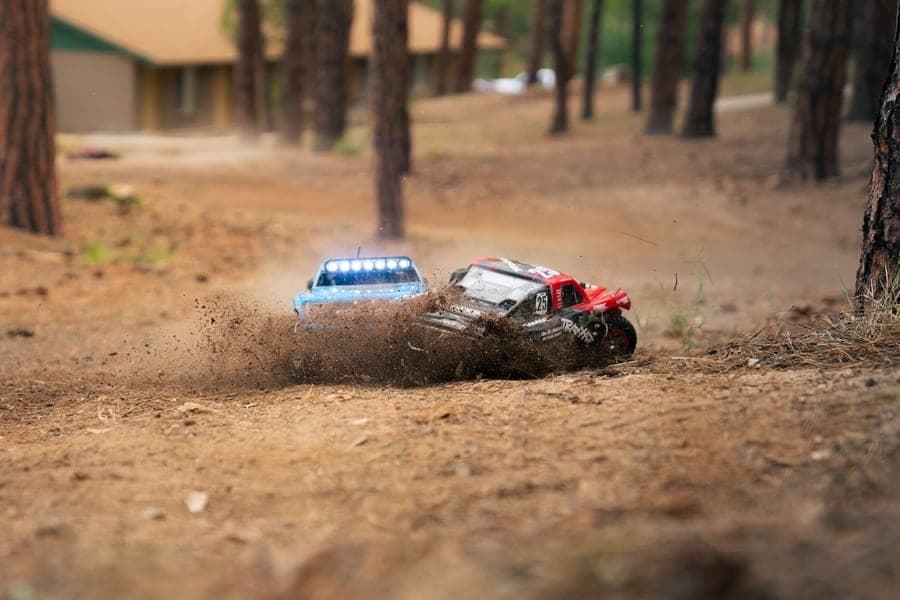 ARRMA Kraton 6S 4x4A large 6S speed truck. Buy this for someone who already has an RC car and wants a bigger one. | Experienced adults | 8.0 |
Illustrative photo — not this exact model.
#1 · Adults who want the big one
Traxxas Maxx
Large, heavy, and built to be jumped off things — a serious machine, not a starter car.
8.2/10our score for this use
A wide-stance monster truck designed around higher-voltage batteries. This is the size and power level people move up to after a year, not the one they start with.
- Size:
- 1/10 (oversized)
- Drive:
- Shaft-driven 4WD
- Motor:
- brushless motor
What it does well
- Built for jumps and hard landings in a way the smaller trucks are not
- Presence: it looks and sounds like a serious piece of equipment
- Full Traxxas parts and upgrade support
What it does badly
- Expensive before you have bought batteries, and it wants big ones
- Genuinely dangerous at speed around people and pets — it needs open ground
- Far too much car for a first-timer of any age
Specifications from Traxxas' model and parts finder.
Illustrative photo — not this exact model.
#2 · Experienced bashers
Traxxas Sledge
The 1/8 six-cell monster truck at the top of the Traxxas basher range. Enormous performance, well past beginner territory.
8.3/10our score for this use
A 1/8 scale brushless monster truck built around the higher-voltage 6S battery class. Traxxas quotes over 55 mph out of the box and 70+ mph with optional gearing, driven through an all-steel driveline, and recommends two 5000mAh 3-cell LiPo packs to run it.
- Size:
- 1/8
- Drive:
- Shaft-driven 4WD
- Motor:
- brushless motor
What it does well
- Steel driveline and a deep-formed aluminum chassis plate — built for landings, not just speed
- Belted Sledgehammer tires stay round at speed, which cheaper tires do not
- Full Traxxas parts support on a truck this size is rare and genuinely valuable
What it does badly
- It wants two 3-cell LiPo packs, which is a large extra cost on top of an already high price
- Completely unsuitable as a first RC car, at any age
- At 55+ mph it needs a field or a track, not a driveway
Specifications from the Traxxas Sledge product page.
Illustrative photo — not this exact model.
#3 · Experienced adults
ARRMA Kraton 6S 4x4
A large 6S speed truck. Buy this for someone who already has an RC car and wants a bigger one.
8.0/10our score for this use
6S refers to the battery: six cells in series, roughly 22 volts, which is a large step up in power from the 2S and 3S vehicles above. This is an expert-level machine that needs open space and respect.
- Size:
- 1/8
- Drive:
- 4WD
- Motor:
- brushless motor
What it does well
- Enormous performance and the build quality to survive using it
- A platform people keep for years and upgrade rather than replace
- Full parts and service support
What it does badly
- Expensive, and 6S batteries are expensive too — this is not a single-purchase gift
- Completely unsuitable for a beginner or a child
- Needs a large open space to use safely
Specifications from ARRMA's current releases.
The obvious cross-brand alternative
The ARRMA Kraton 6S is the truck most people weigh against the Sledge, and it is a fair fight: a 1/8 6S speed truck with the build quality to survive being used as one, and a platform owners keep for years and upgrade rather than replace. The decision usually comes down to parts logistics rather than engineering — Traxxas spares are on a hobby-shop shelf in most towns, while ARRMA's come by mail order from a dealer. If the hobby is new to the household, the shelf matters more than the specification. Traxxas vs ARRMA argues that case in full.
Which to buy
- A big truck you can afford to keep running: the Maxx. 1/10 and 4S is the practical end of this class.
- The top of the Traxxas basher range, no compromises: the Sledge, with two 3S 5000mAh packs and a charger that can fill them.
- You already own 6S packs and a big charger: the Sledge. Most of its running cost is already paid.
- Durability above all, and mail-order spares are fine: the ARRMA Kraton 6S.
- It is a gift and you are unsure: neither — the best RC trucks for adults covers vehicles that are impressive without this commitment.
What you will need alongside it
Batteries, a charger large enough to fill them, and somewhere to charge them safely. At this voltage class a bench charger with two channels is not a luxury — with one channel you spend most of your afternoon waiting. The best RC battery chargers covers the options, and how to store LiPo batteries matters more at this size than at any other, because large packs left fully charged degrade expensively. After that: spare tires, spare suspension arms, and hex drivers that will not round off.
How we assessed this
By comparing the two trucks on the specifications Traxxas publishes, and then on running cost — which is where big bashers are actually decided and where most comparisons stop short. Every figure above is Traxxas' own and is linked in Sources; nothing has been estimated. No price figures appear anywhere on this site; every buy control goes to the live retailer listing. We do not test these products first-hand, and our methodology page explains what that means for a comparison at this level.