Head to head
ARRMA Vorteks vs Granite
Same running gear, same price band, same parts. What you are actually choosing between is a stadium truck and a monster truck — and that decides nearly everything about how it drives.
By Ryder M. · Published October 4, 2026 · Last reviewed
Shock & Servo is reader-supported. If you buy through a link on this page we may earn a commission, at no extra cost to you. It never changes which products we pick or the order we rank them in — the full rules are on our methodology page and our affiliate disclosure.
Buy the Vorteks 223S if the truck will be jumped and driven fast, and the Granite 223S if it will be driven over rough, broken ground or given to someone who wants it to look like a monster truck. Mechanically they are the same family — 1/10 scale, four-wheel drive, brushless 223S power, the same Horizon Hobby parts support. The choice is entirely about the shape sitting on top.
Short version: the Vorteks is a stadium truck — lower, flatter-landing, better in corners. The Granite is a monster truck — taller, more ground clearance, rolls more. For jumping and speed, Vorteks. For a rough yard or a child who asked for a monster truck, Granite.
The comparison table
| Vorteks 223S | Granite 223S | |
|---|---|---|
| Body style | Stadium truck — open wheels, low body | Monster truck — enclosed body, lifted stance |
| Center of gravity | Lower, so it corners flatter | Higher, so it rolls in turns |
| Ground clearance | Less | More |
| In the air | Lands flat, soaks up the impact | More likely to land on a corner and roll |
| Snagging risk | Open wheels catch on curbs and fences | Bodywork covers more of the wheel |
| Scale and drive | 1/10, 4WD | 1/10, 4WD |
| Power | Brushless 223S | Brushless 223S |
| Best for | Jumping, speed, open ground | Rough yards, looks, younger drivers |
What a stadium truck actually is
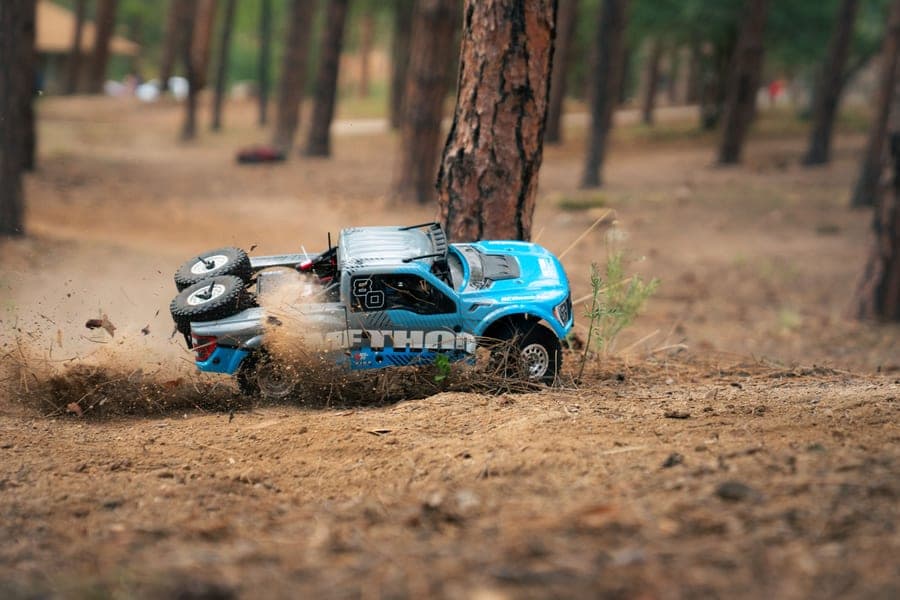
A stadium truck sits between a buggy and a monster truck: open wheels, long suspension travel, a low body, and a layout designed around being jumped. That is the Vorteks. A monster truck is taller, with a full body shell over lifted suspension and more ground clearance — the Granite. Everything that follows is downstream of that single difference.
The low body is why the Vorteks corners better and lands flatter. The tall stance is why the Granite clears a rutted lawn that would ground the Vorteks out, and why it rolls over so much more readily in a hard turn. Neither is a flaw; they are the two halves of the same trade.
The two trucks, side by side
| # | Product | Best for | Score | Price |
|---|---|---|---|---|
| 1 | ARRMA Vorteks 223S 4x4Arrma's stadium truck: lower than the Big Rock, tougher than most things it will land on. | Jumping and landing | 8.6 | |
| 2 | 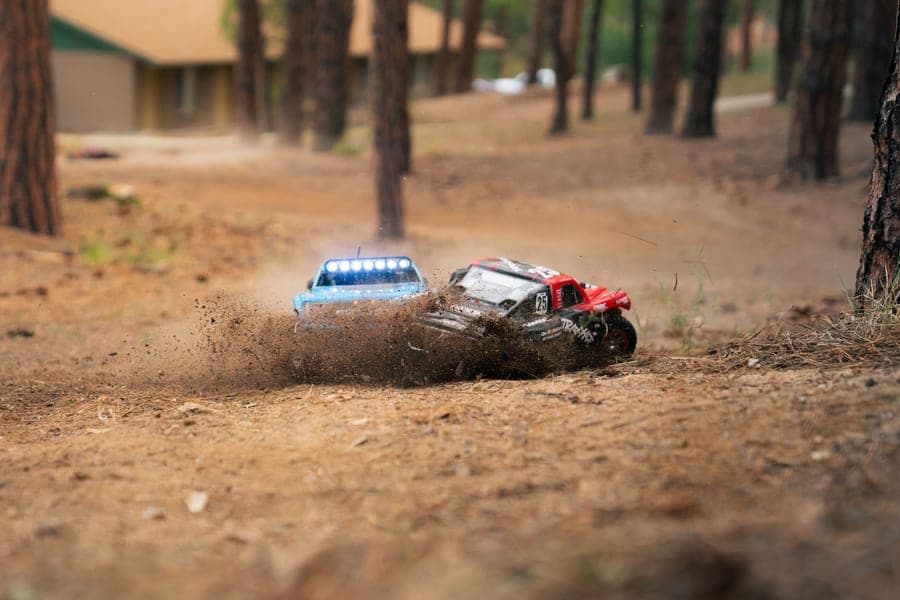 ARRMA Granite 223S 4x4Brushless power in a monster truck built to be crashed — the most common recommendation for a first serious basher. | Best brushless starter | 8.8 | |
| 3 | 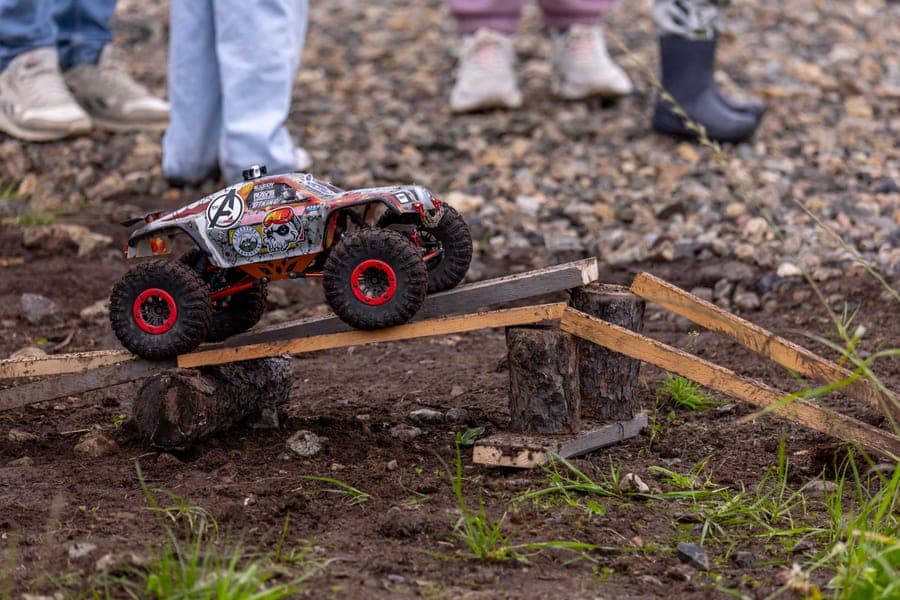 ARRMA Big Rock 223S 4x4The Granite's running gear under a lifted monster-truck body — the one that looks the part. | Monster truck looks | 8.5 |
Illustrative photo — not this exact model.
#1 · Jumping and landing
ARRMA Vorteks 223S 4x4
Arrma's stadium truck: lower than the Big Rock, tougher than most things it will land on.
8.6/10our score for this use
A stadium truck sits between a buggy and a monster truck — open wheels, long suspension, designed to be jumped. The Vorteks is the brushless 1/10 version in Arrma's current line.
- Size:
- 1/10
- Drive:
- 4WD
- Motor:
- brushless motor
What it does well
- Long suspension travel absorbs jump landings that break lesser trucks
- Lower and more stable in corners than a monster truck
- Horizon Hobby parts and service network
What it does badly
- Open wheels snag on fences, curbs and long grass
- Fast enough to need open space
- Battery and charger extra
Specifications from ARRMA's current releases.
Illustrative photo — not this exact model.
#2 · Best brushless starter
ARRMA Granite 223S 4x4
Brushless power in a monster truck built to be crashed — the most common recommendation for a first serious basher.
8.8/10our score for this use
Arrma designs for bashing: heavy-duty plastic, chunky driveshafts, and a reputation for surviving impacts that break lighter cars. The 223S is the current brushless version of its 1/10 monster truck and takes a 2S or 3S battery.
- Size:
- 1/10
- Drive:
- 4WD
- Motor:
- brushless motor
What it does well
- Built heavy on purpose — the brand's whole identity is surviving bad landings
- Brushless power with a 3S option, so it has room to grow with the driver
- Supported through Horizon Hobby, so parts and service have a real distribution network
What it does badly
- The weight that makes it tough also makes it hard on whatever it hits
- Battery and charger are extra on most versions
- Too fast for a young child without adult supervision
Specifications from ARRMA's current releases.
Illustrative photo — not this exact model.
#3 · Monster truck looks
ARRMA Big Rock 223S 4x4
The Granite's running gear under a lifted monster-truck body — the one that looks the part.
8.5/10our score for this use
Same mechanical family as the Granite with a taller stance and a monster-truck body. It trades a little cornering composure for ground clearance and for looking exactly like what a child pictures when they say monster truck.
- Size:
- 1/10
- Drive:
- 4WD
- Motor:
- brushless motor
What it does well
- The most visually impressive truck in this price band on Christmas morning
- Clears rough ground the lower trucks bottom out on
- Shares parts with the rest of Arrma's 1/10 4x4 range
What it does badly
- The tall body rolls in corners — expect a lot of flipping early on
- Heavier again than the Granite, so impacts hit harder
- No battery or charger included on most versions
Specifications from ARRMA's current releases.
Where the Vorteks wins
- Jumping. The long travel and low center of gravity mean it stays level in the air and lands on its suspension rather than its corner. If a ramp is involved, this is the one — see the best RC cars for jumping.
- Cornering at speed. It does not roll, which means a confident driver can carry speed through a turn instead of flipping onto the roof.
- Fewer rollovers to walk over and right. With a child driving, this is a bigger quality-of-life difference than it sounds.
Where the Granite wins
- Rough ground. More clearance means tall grass, ruts and gravel that stop a stadium truck are a non-event.
- Not snagging on things. Open stadium-truck wheels catch on curbs, fence wire and long grass. The Granite's bodywork covers more of the wheel.
- Looking the part. If the recipient said the words monster truck, this is the shape in their head. The Big Rock 223S takes that further again with a lifted body on the same running gear.
What they share, which is most of it
Both are 1/10 scale, four-wheel drive and brushless, both run on 2S or 3S batteries, and both are supported through Horizon Hobby. That means the spares, the service network and the upgrade paths are common, and it means the decision carries less risk than it feels like it does: a wrong choice here is a different body shape, not a different hobby. If you are still weighing ARRMA against something else entirely, ARRMA vs Redcat and ARRMA vs Losi cover the brand-level question, and the best ARRMA bashers ranks the range by how hard it gets driven.
The cost nobody includes
Neither truck ships with a battery or a charger on most versions, which means the real price is meaningfully higher than the sticker. Budget for a 2S or 3S LiPo and a balance charger before either can be driven — that is typically another $100 to $150 the first time. What an RC car really costs covers the whole picture, and 2S vs 3S LiPo explains which pack to start with on a truck that accepts both.
How we compared them
Because the drivetrains are shared, the comparison is almost entirely about geometry: ride height, center of gravity, suspension travel and body coverage, and what each of those does on the ground this truck will actually be driven on. Specifications come from ARRMA's own range pages, linked in the sources. We do not test these trucks first-hand; our methodology page sets out exactly how the picks on this site are chosen.