By what it is built for
The best RC cars for jumping
Anything will leave the ground. What separates these is what happens on the way down — and which parts you will be replacing afterwards.
By Ryder M. · Published October 4, 2026 · Last reviewed
Shock & Servo is reader-supported. If you buy through a link on this page we may earn a commission, at no extra cost to you. It never changes which products we pick or the order we rank them in — the full rules are on our methodology page and our affiliate disclosure.
If the plan is to jump it, buy a stadium truck or a stunt truck with long-travel oil shocks, and our pick is the ARRMA Vorteks 223S — it is lower than a monster truck, so it lands flatter, and ARRMA builds the whole range around the assumption that it will be crashed. The Traxxas Rustler 4X4 VXL is the alternative if parts availability matters more than outright toughness.
Short version: suspension travel decides how well a car jumps, not power. A Vorteks 223S or a Rustler 4X4 VXL at 1/10, an Outcast 4S if the point is stunts rather than distance, and a BEZGAR HM162 if the budget is nearer $100 than $300.
Best overall
ARRMA Vorteks 223S 4x4
Arrma's stadium truck: lower than the Big Rock, tougher than most things it will land on.
Best supported
Traxxas Rustler 4X4 VXL
Very fast, and the only reason it suits a beginner is the built-in Training Mode that halves the power.
Best for stunts
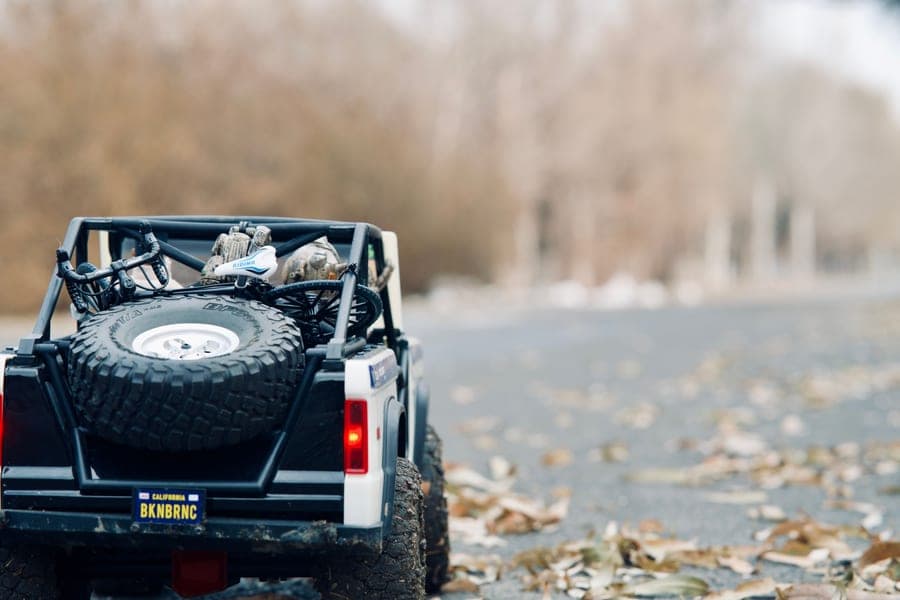
ARRMA Outcast 4S 4x4
The stunt-truck idea at a manageable 1/10 size, with a rubber-tired wheelie bar fitted from the factory.
Why jumping is a suspension question
A jump is three separate events, and a car can be good at one and terrible at the next. Getting airborne needs nothing more than throttle. Staying level in the air is about weight distribution and whether the driver can blip the throttle to rotate the car. Landing is where things break, and that is entirely down to how much travel the suspension has and whether the shocks can absorb the energy without bottoming out.
That last point is where cheap cars fall over. Plastic-bodied shocks hold very little oil, so after a few minutes of hard driving the oil heats up, thins, and stops damping — the car starts landing on its chassis rather than its suspension. Aluminum shocks with more oil capacity hold their damping for a whole battery pack. It is the least glamorous specification on this page and the one that decides everything.
Our picks
| # | Product | Best for | Score | Price |
|---|---|---|---|---|
| 1 | ARRMA Vorteks 223S 4x4Arrma's stadium truck: lower than the Big Rock, tougher than most things it will land on. | Jumping and landing | 8.6 | |
| 2 | Traxxas Rustler 4X4 VXLVery fast, and the only reason it suits a beginner is the built-in Training Mode that halves the power. | Speed, with a limiter | 8.9 | |
| 3 | ARRMA Outcast 4S 4x4The stunt-truck idea at a manageable 1/10 size, with a rubber-tired wheelie bar fitted from the factory. | Stunts at 1/10 size | 8.5 | |
| 4 | ARRMA Notorious 6SThe 1/8 stunt truck: a 2050Kv brushless system, a high-downforce wing, and a chassis meant to be landed on. | Big air and stunts | 8.4 | |
| 5 | 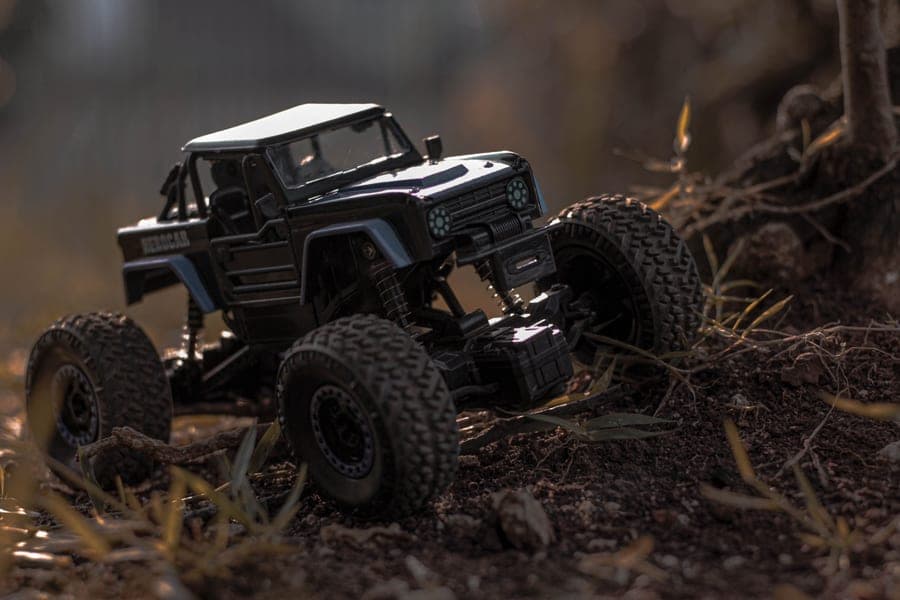 BEZGAR HM162The monster-truck-shaped sibling of the HM161: same idea, more ground clearance. | Taller tires, rougher ground | 7.9 | |
| 6 | Traxxas GTR Long Aluminum ShocksAluminum-bodied oil shocks with 70% more oil capacity than the standard ones, which is what stops them fading. | Landing jumps | 8.5 |
Illustrative photo — not this exact model.
#1 · Jumping and landing
ARRMA Vorteks 223S 4x4
Arrma's stadium truck: lower than the Big Rock, tougher than most things it will land on.
8.6/10our score for this use
A stadium truck sits between a buggy and a monster truck — open wheels, long suspension, designed to be jumped. The Vorteks is the brushless 1/10 version in Arrma's current line.
- Size:
- 1/10
- Drive:
- 4WD
- Motor:
- brushless motor
What it does well
- Long suspension travel absorbs jump landings that break lesser trucks
- Lower and more stable in corners than a monster truck
- Horizon Hobby parts and service network
What it does badly
- Open wheels snag on fences, curbs and long grass
- Fast enough to need open space
- Battery and charger extra
Specifications from ARRMA's current releases.
Illustrative photo — not this exact model.
#2 · Speed, with a limiter
Traxxas Rustler 4X4 VXL
Very fast, and the only reason it suits a beginner is the built-in Training Mode that halves the power.
8.9/10our score for this use
A stadium truck — open wheels, big tires, built to jump. Traxxas states 65+ mph with a 3-cell LiPo and the optional speed gearing, and, crucially, a patented Training Mode that cuts throttle and reverse to 50%. You can hand it to a child on the low setting and unlock the rest later.
- Size:
- 1/10
- Drive:
- Shaft-driven 4WD
- Motor:
- brushless motor
What it does well
- Training Mode cuts the power in half — a genuine answer to "this is too fast for them"
- Waterproof electronics and a waterproof receiver box, so weather stops being a factor
- Traxxas parts support, which is the best in the hobby
What it does badly
- At full power it is a 60-plus mph vehicle. That is not a child's toy, and it needs open space
- No battery or charger included — the real cost is meaningfully higher than the sticker
- Open wheels catch on curbs and fences in a way the Slash's bodywork does not
Specifications from the Traxxas Rustler 4X4 VXL product page.
Illustrative photo — not this exact model.
#3 · Stunts at 1/10 size
ARRMA Outcast 4S 4x4
The stunt-truck idea at a manageable 1/10 size, with a rubber-tired wheelie bar fitted from the factory.
8.5/10our score for this use
A short-wheelbase 1/10 stunt truck built to flip, wheelie and land upside down without caring. ARRMA fits a Spektrum Firma 120A waterproof speed control, steel differential gears, EXtreme Bash driveshafts and a wheelie bar, and runs it on 4S.
- Size:
- 1/10
- Drive:
- 4WD
- Motor:
- brushless motor
What it does well
- The 11.3 inch wheelbase makes it genuinely nimble — it flips and recovers rather than cartwheeling away
- Wishbone dirt guards, outdrive protectors and taller side guards come fitted, not as upgrades
- Smaller and cheaper to run than the 6S trucks while behaving the same way
What it does badly
- Open wheels and a high center of gravity: it rolls constantly, which is the point but still costs parts
- 4S battery and charger are extra
- Too fast and too aggressive for a younger child
Specifications from the ARRMA Outcast 4S product page.
Illustrative photo — not this exact model.
#4 · Big air and stunts
ARRMA Notorious 6S
The 1/8 stunt truck: a 2050Kv brushless system, a high-downforce wing, and a chassis meant to be landed on.
8.4/10our score for this use
A stunt truck is a monster truck geared and balanced for jumping rather than racing. The Notorious pairs a 2050Kv motor with the BLX185 speed control on 4S or 6S batteries, rides on multi-terrain dBoots BACK-FLIP tires, and ARRMA quotes 60+ mph.
- Size:
- 1/8
- Drive:
- 4WD
- Motor:
- brushless motor
What it does well
- Adjustable 4mm oil-filled shocks on aluminum towers soak up landings that break lesser trucks
- Waterproof electronics and a factory-fitted metal-geared servo
- Runs 4S as well as 6S, so it can be driven at lower power while the driver learns it
What it does badly
- 6S batteries are a serious additional expense and are not included
- Big, heavy and fast — it damages what it hits, including itself
- Not a gift for a child, and not a first RC car
Specifications from the ARRMA Notorious 6S product page.
Illustrative photo — not this exact model.
#5 · Taller tires, rougher ground
BEZGAR HM162
The monster-truck-shaped sibling of the HM161: same idea, more ground clearance.
7.9/10our score for this use
The same 1:16 platform in monster-truck form, with taller tires. BEZGAR quotes a top speed above 40 km/h and supplies two rechargeable packs.
- Size:
- 1:16
- Drive:
- 4WD
- Motor:
- brushed motor
What it does well
- Taller tires clear lawn thatch and gravel that stop lower cars
- Two batteries included
- Replacement parts sold by BEZGAR directly
What it does badly
- The higher body rolls over in hard turns more readily than the HM161
- No hobby-shop parts availability
- The charger in the box is slow
Specifications from BEZGAR's HM162 product page.
Illustrative photo — not this exact model.
#6 · Landing jumps
Traxxas GTR Long Aluminum Shocks
Aluminum-bodied oil shocks with 70% more oil capacity than the standard ones, which is what stops them fading.
8.5/10our score for this use
Shock absorbers control how the suspension moves. The standard plastic-bodied shocks hold little oil, so after a few minutes of hard driving the oil heats, thins and the truck starts bottoming out. Traxxas' GTR shocks are aluminum with titanium-coated shafts and, by the company's own figure, 70% greater oil capacity.
What it does well
- Consistent damping through a whole battery pack rather than just the first three minutes
- Rebuildable: you replace the oil and seals rather than the whole shock
- Springs are sold separately, so the truck can be tuned for how it is actually driven
What it does badly
- Sold in pairs, so a full set is two purchases
- Only worth the money if the truck is genuinely being jumped
- Rebuilding shocks is fiddly and easy to get wrong the first time
Specifications from the Traxxas Slash 4X4 upgrade guide.
What breaks when you jump, and in what order
| Part | Why a jump kills it | What helps |
|---|---|---|
| Front suspension arms | Nose-first landings put the whole weight of the car through one arm | Heavy-duty arms, and landing level rather than nose-down |
| Shock shafts and bodies | Bottoming out repeatedly bends shafts and scores the bodies | Aluminum, oil-filled, rebuildable shocks with real travel |
| Body shell posts | The shell flexes on impact and tears around the mounting holes | Body washers and reinforcement tape, which cost almost nothing |
| Driveshafts and outdrives | Wheels spinning in the air then suddenly gripping shock-loads the driveline | Steel driveshafts, outdrive protectors, and lifting off before touchdown |
| The steering servo | A hard landing on a turned wheel drives the impact back into the servo gears | A metal-geared servo, which most hobby-grade trucks already have |
Stadium truck, monster truck or stunt truck?
- Stadium truck — open wheels, long travel, low body. The best all-round jumper, and the shape built for exactly this. The Vorteks and the Rustler are both this shape.
- Monster truck — taller, heavier, more ground clearance. Better over rough approaches, worse in the air because the high center of gravity makes it roll. Covered in the best RC monster trucks.
- Stunt truck — short wheelbase, wheelie bar, built to flip and recover rather than to land cleanly. The Outcast 4S and Notorious 6S are these, and they are a different hobby from jumping for distance.
- Short-course truck — enclosed wheels, which makes it the most crash-tolerant shape overall but adds weight high up. Fine for jumping, better for everything else.
The driving technique nobody mentions
Most jump damage is avoidable, and the fix is throttle control rather than parts. A four-wheel-drive car can be rotated in the air: a stab of throttle lifts the nose, letting off drops it. Landing with all four wheels spinning at roughly the speed the car is traveling is what stops the driveline being shock-loaded. Beginners do the opposite — full throttle off the ramp, nothing in the air, and a nose-down landing on locked wheels. That sequence breaks front arms, and it does it repeatedly.
What jumping costs to keep doing
A car that gets jumped consumes parts. Budget for a set of front suspension arms and a pair of shocks in the first season, which on a well-supported brand is around $50 to $80 of spares. That is the real argument for Traxxas and ARRMA here over a cheaper truck — not that they break less, but that the part is in a hobby shop or shipping next day rather than on a four-week boat. What breaks first on an RC car sets out the whole repair picture, and the first upgrades worth making explains which parts are worth buying before something breaks.
How we picked
Suspension travel and shock quality first, then chassis shape, then parts availability — because a jumper that cannot be repaired stops being a jumper. Power came last, deliberately: every car here already has more than enough to clear a ramp. Specifications come from each manufacturer's own product page, linked in the sources below. We do not test these products first-hand; our methodology page explains exactly what we do instead.