Fast, for adults
100 mph RC cars: what actually gets there
The search is for a hundred miles an hour. The honest answer is that one ready-to-run car in the whole hobby is sold on that number, and it is not the one you want. Here is the class that gets closest, and what it genuinely does.
By Ryder M. · Published October 6, 2026 · Last reviewed
Shock & Servo is reader-supported. If you buy through a link on this page we may earn a commission, at no extra cost to you. It never changes which products we pick or the order we rank them in — the full rules are on our methodology page and our affiliate disclosure.
If you want the fastest RC vehicle you can buy, drive and repair without becoming an engineer, buy a 6S class truck — and the Traxxas Sledge is the one to get, because Traxxas quotes over 55 mph out of the box and 70+ mph with optional gearing, and because every part of it is stocked in hobby shops across the country. It will not do 100 mph. Almost nothing you can order, unbox and drive will. The hundred-mile-an-hour figure that fills search results belongs to one specialist Traxxas model built for a straight line, to heavily modified cars running batteries and gearing their owners chose themselves, and to a great many listings quoting kilometers per hour and hoping you do not look.
Short version: 100 mph is not a ready-to-run figure. The realistic ceiling for an off-the-shelf car you can actually use is 55 to 70 mph, which is the 6S class on this page. Buy the Traxxas Sledge for parts support, the ARRMA Notorious 6S if the point is jumping it, and read the speed section below before you spend anything.
The honest speed table
| Class | What the maker states | What that costs | Who it suits |
|---|---|---|---|
| Toy-grade, under $50 | 10-20 mph | Nothing extra | Children under eight |
| Brushed hobby-grade 1/10 | 20-30 mph | Battery and charger | Beginners of any age |
| Brushless 2S-3S 1/10 | 30-45 mph | Battery and charger | Teens and adults, first fast car |
| 6S class, 1/8 | 55-70+ mph (Sledge: 55 mph stock, 70+ geared) | Two large LiPo packs plus a real charger | Experienced adults with open ground |
| Dedicated speed-run models | Around 100 mph, on a straight | A long, empty, legal strip of asphalt | Specialists — not a general-purpose car |
Why 100 mph is the wrong number to shop by
Speed in this hobby is a function of three things the owner controls: battery voltage, gearing, and how much grip the tires can hold before the car simply spins. A 6S truck geared for acceleration will do 55 mph and jump beautifully. The same truck geared for top speed will go faster in a straight line and be considerably worse at everything else. The 100 mph cars you have seen on video are almost always at the second end of that trade, on a closed road, with a driver who knows a crash at that speed is a total loss.
There is also a practical ceiling nobody mentions. At 60 mph a 1/8 truck crosses a soccer field in about four seconds. You cannot see which way it is pointing from one end, and you certainly cannot react to it. The limit on usable speed is your eyesight and the size of the space, not the motor — which is why experienced owners of 6S trucks mostly drive at half throttle and spend the rest of their money on batteries.
What to look for in a genuinely fast car
- A steel or aluminum driveline. Composite driveshafts are fine behind a brushed motor and marginal behind 6S power. The Sledge uses an all-steel driveline and a deep-formed aluminum chassis plate for exactly this reason.
- Belted tires. Above about 40 mph an unbelted tire balloons under centrifugal force, loses its shape and ruins the handling. Belted tires — the Sledge ships with Sledgehammers — stay round.
- Oil-filled shocks on aluminum towers. Speed means landings, and landings are what break the plastic-bodied shocks fitted to cheaper trucks.
- Lower-voltage compatibility. The Notorious runs 4S as well as 6S, so a new owner can learn the truck at two-thirds power before unlocking the rest. This is the most useful single feature on a fast car.
- Parts you can actually get. At this speed you will break things. A truck whose spares ship from one overseas warehouse is a truck that spends months on a shelf.
The four fastest trucks we recommend
| # | Product | Best for | Score | Price |
|---|---|---|---|---|
| 1 | 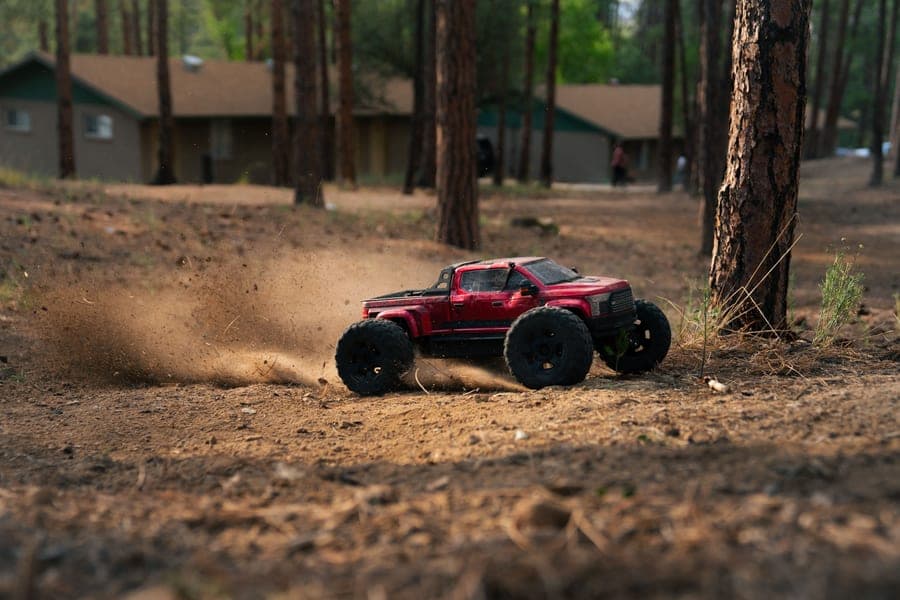 Traxxas SledgeThe 1/8 six-cell monster truck at the top of the Traxxas basher range. Enormous performance, well past beginner territory. | Experienced bashers | 8.3 | |
| 2 | 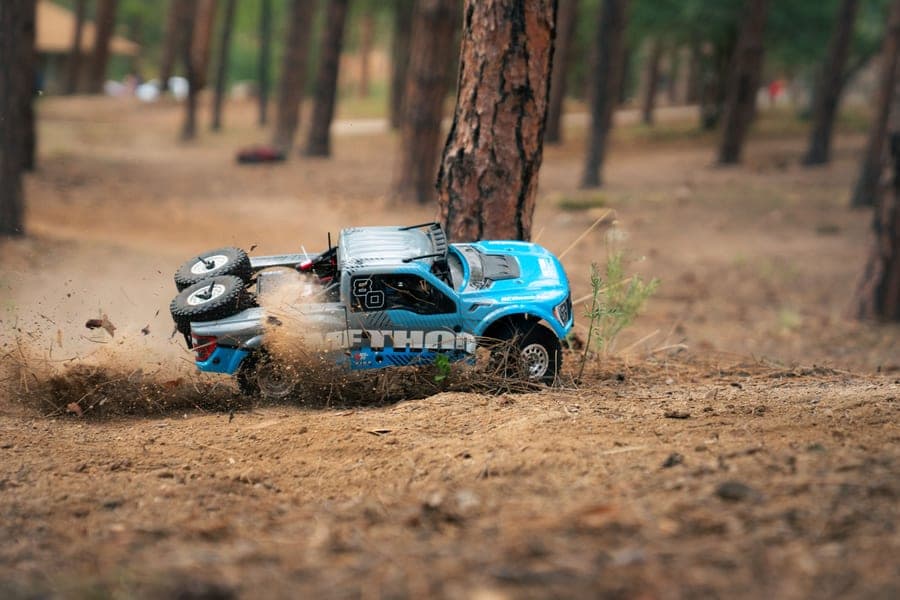 ARRMA Notorious 6SThe 1/8 stunt truck: a 2050Kv brushless system, a high-downforce wing, and a chassis meant to be landed on. | Big air and stunts | 8.4 | |
| 3 | ARRMA Kraton 6S 4x4A large 6S speed truck. Buy this for someone who already has an RC car and wants a bigger one. | Experienced adults | 8.0 | |
| 4 | Traxxas MaxxLarge, heavy, and built to be jumped off things — a serious machine, not a starter car. | Adults who want the big one | 8.2 |
Illustrative photo — not this exact model.
#1 · Experienced bashers
Traxxas Sledge
The 1/8 six-cell monster truck at the top of the Traxxas basher range. Enormous performance, well past beginner territory.
8.3/10our score for this use
A 1/8 scale brushless monster truck built around the higher-voltage 6S battery class. Traxxas quotes over 55 mph out of the box and 70+ mph with optional gearing, driven through an all-steel driveline, and recommends two 5000mAh 3-cell LiPo packs to run it.
- Size:
- 1/8
- Drive:
- Shaft-driven 4WD
- Motor:
- brushless motor
What it does well
- Steel driveline and a deep-formed aluminum chassis plate — built for landings, not just speed
- Belted Sledgehammer tires stay round at speed, which cheaper tires do not
- Full Traxxas parts support on a truck this size is rare and genuinely valuable
What it does badly
- It wants two 3-cell LiPo packs, which is a large extra cost on top of an already high price
- Completely unsuitable as a first RC car, at any age
- At 55+ mph it needs a field or a track, not a driveway
Specifications from the Traxxas Sledge product page.
Illustrative photo — not this exact model.
#2 · Big air and stunts
ARRMA Notorious 6S
The 1/8 stunt truck: a 2050Kv brushless system, a high-downforce wing, and a chassis meant to be landed on.
8.4/10our score for this use
A stunt truck is a monster truck geared and balanced for jumping rather than racing. The Notorious pairs a 2050Kv motor with the BLX185 speed control on 4S or 6S batteries, rides on multi-terrain dBoots BACK-FLIP tires, and ARRMA quotes 60+ mph.
- Size:
- 1/8
- Drive:
- 4WD
- Motor:
- brushless motor
What it does well
- Adjustable 4mm oil-filled shocks on aluminum towers soak up landings that break lesser trucks
- Waterproof electronics and a factory-fitted metal-geared servo
- Runs 4S as well as 6S, so it can be driven at lower power while the driver learns it
What it does badly
- 6S batteries are a serious additional expense and are not included
- Big, heavy and fast — it damages what it hits, including itself
- Not a gift for a child, and not a first RC car
Specifications from the ARRMA Notorious 6S product page.
Illustrative photo — not this exact model.
#3 · Experienced adults
ARRMA Kraton 6S 4x4
A large 6S speed truck. Buy this for someone who already has an RC car and wants a bigger one.
8.0/10our score for this use
6S refers to the battery: six cells in series, roughly 22 volts, which is a large step up in power from the 2S and 3S vehicles above. This is an expert-level machine that needs open space and respect.
- Size:
- 1/8
- Drive:
- 4WD
- Motor:
- brushless motor
What it does well
- Enormous performance and the build quality to survive using it
- A platform people keep for years and upgrade rather than replace
- Full parts and service support
What it does badly
- Expensive, and 6S batteries are expensive too — this is not a single-purchase gift
- Completely unsuitable for a beginner or a child
- Needs a large open space to use safely
Specifications from ARRMA's current releases.
Illustrative photo — not this exact model.
#4 · Adults who want the big one
Traxxas Maxx
Large, heavy, and built to be jumped off things — a serious machine, not a starter car.
8.2/10our score for this use
A wide-stance monster truck designed around higher-voltage batteries. This is the size and power level people move up to after a year, not the one they start with.
- Size:
- 1/10 (oversized)
- Drive:
- Shaft-driven 4WD
- Motor:
- brushless motor
What it does well
- Built for jumps and hard landings in a way the smaller trucks are not
- Presence: it looks and sounds like a serious piece of equipment
- Full Traxxas parts and upgrade support
What it does badly
- Expensive before you have bought batteries, and it wants big ones
- Genuinely dangerous at speed around people and pets — it needs open ground
- Far too much car for a first-timer of any age
Specifications from Traxxas' model and parts finder.
What this really costs
The sticker price of a 6S truck is roughly half the real spend. None of the four above includes a battery, and they want large ones — Traxxas recommends two 5000mAh 3-cell packs for the Sledge, which together cost a meaningful fraction of the truck. Add a charger that can handle them at a sensible rate and a LiPo-safe bag, and the entry cost of the class is far higher than the price tag suggests. How much an RC car costs breaks the whole figure down, and the best RC battery chargers covers the piece of equipment people under-buy most often.
If you are buying this as a gift
Then almost certainly do not buy from this page. A 6S truck handed to someone who does not already own an RC car is an expensive way to produce a broken truck and a disappointed recipient — all four of these are listed by their makers for ages sixteen and up, and all four need a field. If the recipient is an adult who has never owned one, the best first RC cars and RC cars for adults are the right starting points, and both include cars in the 30 to 45 mph range that feel genuinely fast without being unusable.
How we assessed this
By taking the 100 mph claim at face value and then checking it against what the manufacturers themselves publish. Every speed figure above is the maker's own stated number, linked in Sources; where a figure exists only in kilometers per hour we have converted it and said so. We do not test these products first-hand and we have measured none of these speeds — our methodology page explains exactly what that means and how the picks are chosen.